The Aesthetics of Truth: Peder Haugfos deepdives into how we design for trust

For ages, 𝔗𝔥𝔦𝔰 𝔱𝔶𝔭𝔬𝔤𝔯𝔞𝔭𝔥𝔶 𝔦𝔰 𝔱𝔥𝔢 𝔴𝔞𝔶 𝔴𝔢 𝔱𝔢𝔩𝔩 𝔱𝔥𝔢 𝔱𝔯𝔲𝔱𝔥. Black text on white paper has been how we communicate the truth. With TV, Radio, and the internet, we have new ways of telling the accepted truth to a big audience. With the massive adaptation of Social Media (SoMe) and AI-features, “the truth” is now threatened.
Radio took 38 years to reach 50 million users, TV took 13, the internet 3, Facebook took 1 year, and Pokemon Go only 19 days. The massive adoption in our time gives new opportunities to reach large masses, but will the audience still trust us when we experiment with new aesthetics and storytelling far from the traditional standards for telling the truth? In this article, I will explain my take on how we can design journalism to ensure people see your journalistic content as trustworthy.
Design for trust
A trust exists where the one that gives trust is either an individual, an organisation, or a system, and the one that receives trust is either an individual, an organisation, or a system. In today’s complex society, trust is regarded as the mechanism that makes society go around because the trust mechanism can reduce complexity. It enables people to act and choose based on their limited knowledge about anything. Media institutions aim to leave an impression of who deserves trust and distrust where deemed appropriate. To ensure this basic task, consumers must have trust in journalism itself.
One can assume that Public Service Media are having significant issues (!) in reaching out to its broad, young audience across multiple platforms. Commercial institutions, companies, brands, influencers, etc., are using sponsored posts, paid placement, celebrities and more, to hit their consumers, but legacy media companies can't.
Aesthetic Journalism and distrust
Research in the field of aestheticisation in journalism faces contradictions caused by current trends in the media field. Among the discussion areas is the artistic techniques penetration into journalism, which expands the range of expressive possibilities but at the same time signifies a retreat from traditional professional standards. Below is an example from Norway and Schibsted's VG - Verdens Gang AS (Read the full article here). VG is the biggest newspaper in Norway. They have a "fit for platform strategy" that aims to hit wide, fragmented young target groups across multiple platforms. This forces VG to follow platform-oriented aesthetic trends. This strategy resonates with the ‘News-finds-me’ mindset, where people are involuntarily stumbling over the news, which has become the dominant mode of news acquisition today. VG is not concerned with being perceived as the same brand, nor is it so concerned with getting clicks back to its own platforms. Instead, it prioritizes pushing VG out in as many places as possible. This leads to the fact that young people see VG differently across platforms. This way of presenting journalism challenges professional standards on a big scale. Below is an example from VG on Snapchat trying to tell a story about sharks coming into the Norwegian fjords. It looks more like advertising for a motion picture. Do you think the audience's sees this as trustworthy?
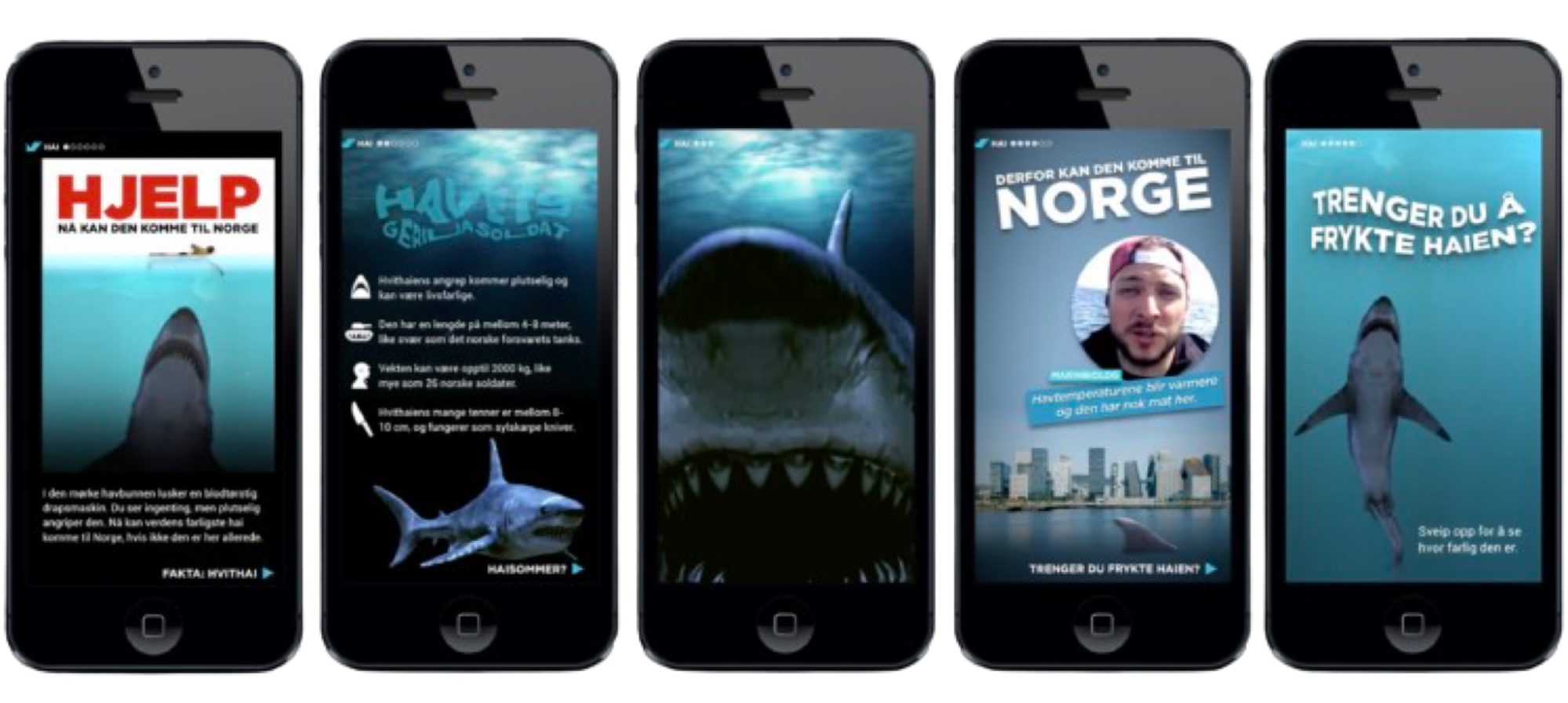
Some researchers argue that the lack of documentary features in the field of journalism is muddying the distinction between journalism and art. The dysfunctional character of some journalistic practices is also connected to the aestheticization of the ugly, which is highly connected to modern aesthetic trends. Considering digital spheres, such as websites and feeds, research shows a correlation between visual aesthetics, usability, satisfaction, pleasure, and accessibility. Aesthetically pleasing web pages enhance the credibility of websites by up to 90%. Some research also shows that users make their first impressions of a web page aesthetically very quickly, which keeps their impressions to remain stable.
Gen Z and Sensory Journalism
Gen Z is attracted to sensory journalism, defined as news content that engages its audience's senses visually and sonically. A comprehensive study done by Brodeur Partners in 2018 found that nearly 48% of Generation Y and 47% of Generation Z prefer news media with elements of augmented reality. Generation Z even favours visual-only platforms, like Instagram and Snapchat. This has led to Gen Z’s media consumption choices fuelling the growth of visual over verbal, where they prefer photo-based content over word-based articles. If one thinks that social media are primary platforms for young people's news consumption today, these people are seeing content that is no longer medium or publication-specific. At the same time, broadcasters and legacy media companies get more homogenised. We live in a time called the ‘Age of The Average’, where content and brands are getting more similar, and no one dares to be disruptive.
CNN, The Washington Post, and NPR look much more similar today than they did three decades ago. Considering these trends, one can question the tendencies of how legacy media gets inspired by traditional marketing and branding strategies in the competition for a digital audience. Different research on online legacy media has stated that many websites, in terms of brand extensions, use the same brand name in different channels to leverage the brand’s equity. Brand equity clarifies itself both indirectly as brand awareness and brand image and also directly as different consumer behaviour.
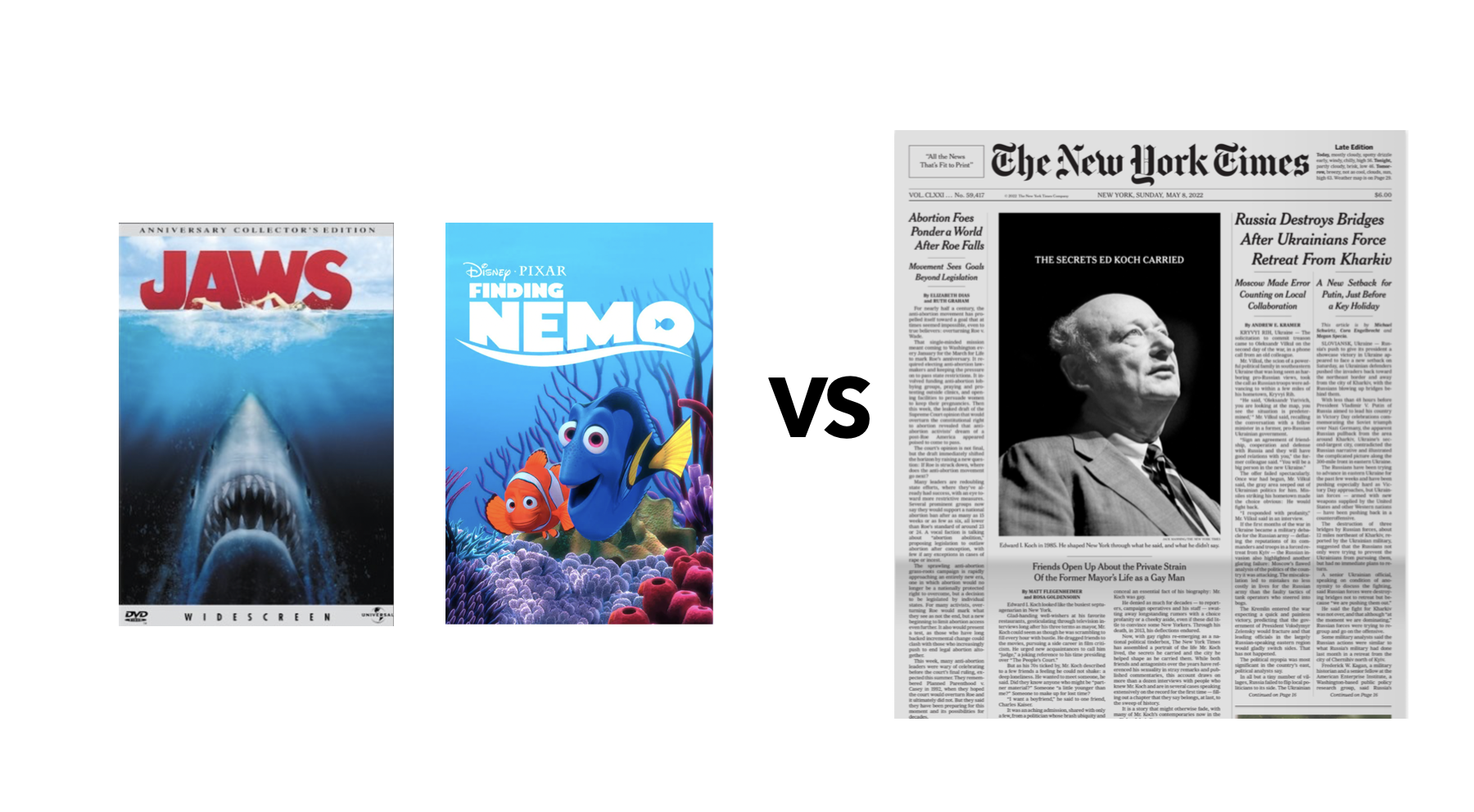
Cramerotti discusses that artists and journalists use aesthetics in their work. According to Nash, even the most disinterested or written piece is anything but neutral and it is coded as a Hollywood movie. Journalism should be a service in the interest of the highest number of people and Williams and Delli Carpini state that journalism as a coded, professional practice establishes a cultural and social order. People read conventions of representation as the reality itself. One accepts the journalistic attitude as a bearer of linguistic and visual documents of reality because it relates occurrence to a pattern immediately understandable to one's mind frame. This means that the visual representation of journalism a reader sees it, can even be categorised as a presentation of reality itself. In other words, the visuals and aesthetic choices have a strong influence on how people perceive things as trustworthy or not. Finding Nemo or JAWS 2 is not the truth and should, therefore, not inspire how we tell the truth.
Artificial Intelligence - A chapter on its own
AI is revolutionizing journalism by enhancing efficiency, personalization and content creation, but its impact on the perception of trustworthiness is nuanced. AI-powered algorithms are increasingly utilized to sift through vast amounts of data, identify trends, and generate news articles at unprecedented speeds. While this automation streamlines the news production process, concerns arise regarding the potential for bias and misinformation perpetuation. Furthermore, AI-driven recommendation systems personalize news feeds based on user preferences, potentially creating filter bubbles and reinforcing existing beliefs.
However, AI also holds promise in fact-checking and verification processes, offering tools to combat misinformation and bolster journalistic integrity. Ultimately, the trustworthiness of AI-driven journalism depends not only on the accuracy and transparency of algorithms, but also on the ethical considerations guiding their development and implementation. As AI continues to evolve, its role in journalism will undoubtedly shape perceptions of trustworthiness, necessitating ongoing scrutiny, regulation and ethical stewardship to maintain the integrity.
How to deal with this as a broadcaster?
Gen Z turns to their peers and trusted communities before trusting outside experts. Furthermore, they collectively boycott organisations they do not believe in. In the age of the average there is an age of opportunity.
❏ When everyone goes online, you go to the newspaper
❏ When everyone goes on social media platforms, you boycott and try out the decentralized Fediverse and niche social platforms.
❏ When everyone tries to make a seamless tone of voice at the big masses, you start aiming narrow by tapping into the massive subcultures.
❏ Broadcast and Legacy Media must think twice before changing to new, untrustworthy platforms and formats for telling the truth.
❏ Boycott trends and try being strict over time is the way to earn trust in the long run. Instead of leaning on 3rd party platforms and trends from the ad world, try to keep up with your standards, experiment with niche social platforms and community engagement IRL, and find new ways to lead audiences home to your trustworthy website or app where you can guarantee provenance.
I would end this article by giving a shoutout to BBC´s disruptor Ian Forrester, who inspires me a lot to think of new ways of building new lock-in effects and leading people out of social media and into our own platforms, for example BBC´s Adaptive podcasting - the future of personalized podcast experiences.
And at the very end of my last chat with BBC´s Henry Cooke I picked up a sentence for reflection:

Article written by Peder Haugfos
This article is based on a comprehensive literature review that I conducted in connection with my latest publication, "How to Rizz Gen Z” with legacy media content. If you want to read more check out the publication here.
Aesthetics of the truth:
The medium is the message, social platforms such as TikTok does not award new formats. It dead appears fully from the feeds. The only currency on TikTok is Attention. (Hard Fork, podcast NYC TIMES)
Then: quote on 8-sec world. Og litt om at d bryter m å skape dybdeforståelse og redaktøransvaret.
Then: Jouinfluencers. Journalists need to learn more from the creators economy.
Quote: the content they publish and mission finding truth no longer enough
Så et lite avsnitt med at 3’rd party platforns ikke kan gjøre oss avhengige. Hva hvis TikTok blir bænna?


