The Art of Bringing your Content Alive

The general feeling of South by Southwest can be summarised as FOMO. But when walking around in Austin, you could also feel the happiness and joy of being at such a big festival in the US. People were smiling, giving you compliments and just experiencing a general festival rush. The opening speaker even talked about how Sikh wisdom can transform your life. Simran Jeet Singh, author and Executive Director of the Religion and Society Program at The Aspen Institute, taught us to see the light in every interaction. And in seeing the light within yourself, in one another and in your environment, you can experience inner peace. Let’s try to find that light while telling you all about how media can immerse their consumers with their content and storytelling.
The first and foremost session we should address today is ‘Creating Happiness: The Art & Science of Disney Parks Storytelling’. In this session, Josh D’Amaro, Chairman at Disney Parks, Experiences & Products, gave us insights into their three core elements (storytelling, creativity and innovation) and how they create happiness.
Disney’s happiness
At the core of Disney’s strategy is Walt's vision to make their customers as happy as possible through shared experiences. Visitors get to live in a ‘Disney bubble’ during their whole stay to experience carefree, childlike fun. They are immersed in a new, wonderful world and every single aspect and detail in a Disney Park stands in service of this immersive experience. They do everything they can to let even the smallest storybook elements come to life, ranging from a real river running through a hotel lobby to the visual and sound effects in the Star Wars world. Every single aspect (going from food to music, visual effects, the characters and so much more) in the customer experience, contributes to making the story as strong and immersive as possible. Because the more immersive the experience can be, the more happiness you can create. And from an economic perspective, happy customers also means economic growth.
“When all comes together, you can help a person to forget the outside world and experience true happiness.”
Josh D’Amaro, Chairman at Disney Parks, Experiences & Products.
Of course you can’t create these strong stories without innovation. Disney calls their innovators ‘imagineers’ (imagination engineers who blend creative imagination with technical expertise and innovation) and showed us on stage some of their newest technical innovations. In the previous article, you could already see robot Judy Hopps from the Disney film Zootopia crawl out of a box and do a somersault, but the imagineers also showed us the newest, state-of-the art lightsabers from the Star Wars franchise. Although we unfortunately didn’t receive one for ourselves, we got to experience the live visual and sound effects of a real lightsaber coming to live, just like in the movies.
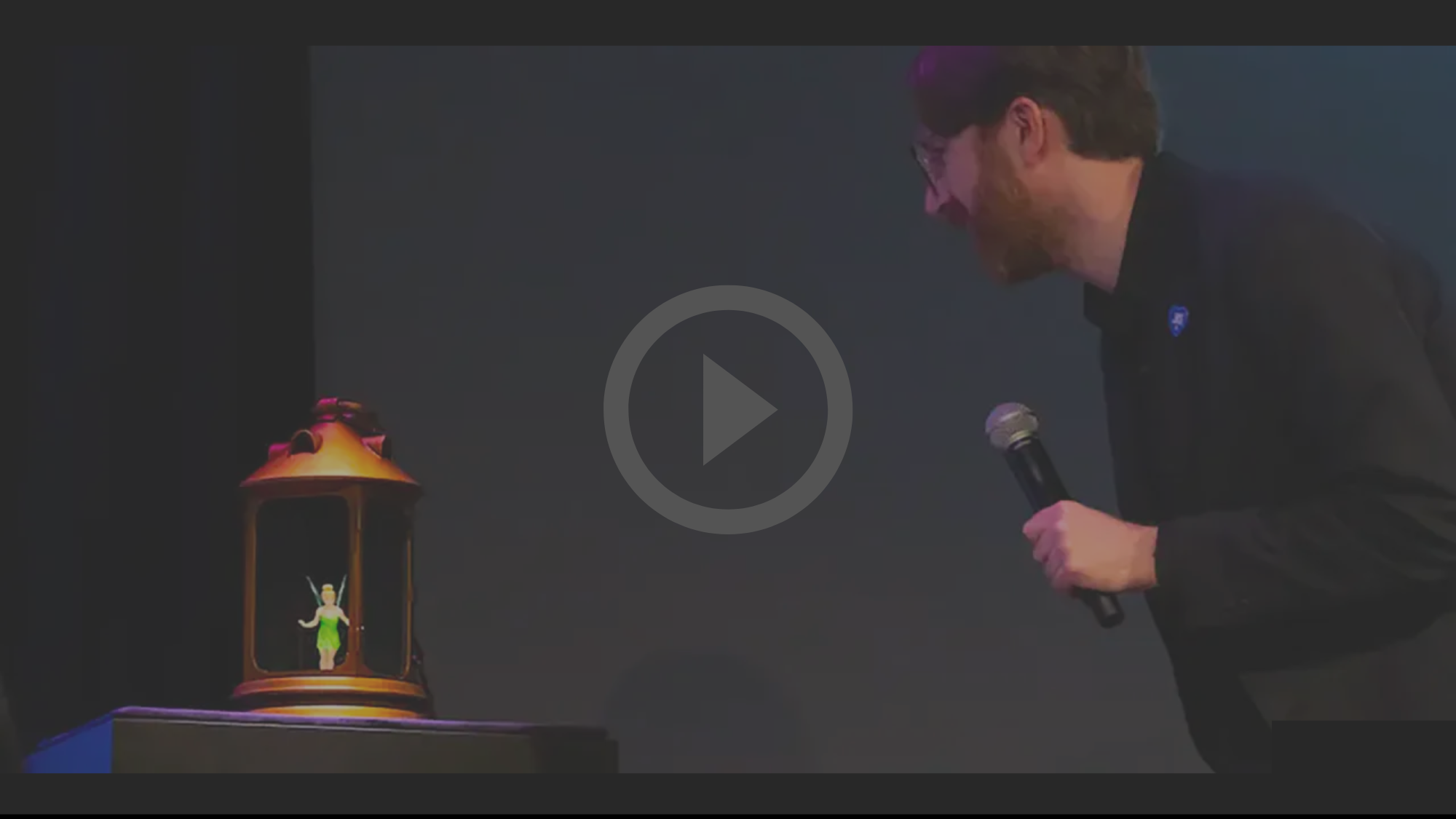
Innovative projects like this start in the R&D department with just the idea. “What if we could make a real lightsaber? Wouldn’t that be so cool?!” And then imagineers just start building prototypes with the tools they have or can 3D print. In the end, everything is custom-made, but the details are being kept a secret. The imagineers are basically Lego builders with a specific vision in mind and they often use nature as an inspiration. For example The Hulk joined us in the crowd wearing a spacesuit. While the audience was still in awe, the imagineers explained that a human person is wearing an exoskeleton that makes it possible for him to move in a natural (although Hulk-like) way. But what to do when a movie character is small, for example as small as a fairy? With the help of their own AI studio and a live performer, they were able to create a Tinkerbell that seems completely real. She was a sassy little girl, having no trouble speaking for such a large crowd.
The Creator Economy
But enough about Disney (for those of you who want to know more, you can watch the full session on YouTube). There were a lot of other sessions that gave us the biggest insights in how to bring our stories alive. We’ve followed one about Next Gen Entrepreneurship and the ‘Rise of the Creator Economy’ and we learned that creators are building strong brands that traditional media companies can learn from. Harley Finkelstein (President at Shopify) Samir Chaudry and Colin Rosenblum (Co-founders of Coolin and Samir) start their conversation by saying that the accessibility of the internet meant that creators could build their own digital store where people pass by and go in, just like we still do when window shopping in our cities. This online viewing gives creators the opportunity to build their own brand, based on credibility and authenticity.
By building a brand in the creator economy rather than the traditional gatekeeper economy, you are able to go directly to the consumer, which in turn can lead to a larger consumer base and more success. We also see that consumers are increasingly more focused on these individuals and authentic brands instead of bigger corporations. Take for example MrBeast, the biggest and most wealthy YouTube star in the world. Based solely on his YouTube channel, he was able to build an entire chocolate and burger joint empire and he even got his own documentary last year. (Watch The Origin and Rise of MrBeast here).
In the first panel of the Future Media Hubs session ‘Shaping The Future of Media Together: A Transatlantic Dialogue on Innovation’, we also talked about the content industry. While everyone thinks Netflix will be the biggest winner, they and other large platforms (such as Apple or Disney) are actually reaching less people than creators on YouTube. In the discussion between Evan Shapiro (media cartographer at Eshap), Sander Saar (futurist and creator) and Johan Oomen (Head of Research at the Netherlands Institute for Sound and Vision), Shapiro even stated that creators like MrBeast are actually killing the content game since they are manufacturing more intellectual property than all associated media together. Sander agrees and gives the examples that for every tv-executive, there are thousands of TikTok creators and on YouTube, there are 500 hours of content uploaded every minute. But the future of American and European media is intertwined and the US is actually a big market for European content. Learn more about this and other content insights in the article of the Future Media Hubs session.
In the creator economy, building relationships with your audiences and getting customer engagement is as important as the technology and data you’re using. During the ‘Return on Attention: How Technology is Reshaping Performance’, John Hagel, CEO of Beyond Our Edge, stated that your “customers are a sacred ressource”. Rather than focusing on how much it will cost your company to reach them, you should focus on their return on attention. When a consumer gets the right value in return, (s)he is more than willing to spend time and effort on your company. When talking about ‘the Reboot of Media’, Evan Shapiro even mentioned it himself: consumers are happy to pay, as long as you give them the right content. It is no longer ‘yes’ versus ‘no’ , it is a story of ‘yes and’, where consumers are making different streaming bundles for themselves based on the content that they want. This aligns again with the Return on Attention point of view where we, as a media company, have to focus on the customer needs in order to stay alive.
Content moderation
We already briefly touched upon the fact that creators experience a lot of trust from their consumers because their content is directly open for everyone to see. But that also means that the public can sometimes be eager to comment below video’s, sometimes even in a disrespectful or even hateful way. How do content creators deal with that and how should a media organisation handle hurtful or unethical comments on their social media? With these questions in mind, we’ve followed the session ‘Evolving Content Moderation: The Next 10 Years’.
The panel starts with arguing that the problem of content moderation has become a multi-stakeholder problem, since it touches every sector of society. With the ever-changing media ecosystem, there is still no real organisation in place that can actually address the multi-challenging problem of content moderation. Until 2018, there was even no transparency at all in how companies moderated their content. Facebook and YouTube were the very first ones at that time to give more details into their set of guidelines and rules. Now, Meta has its own independent Oversight Board in place where they select abuse cases to set up specific and binding rules for content moderation and policy recommendations for Meta.
For the panel members, independent organisations such as the Oversight Board are the new model for content moderation. We need some sort of institution that exists outside of companies and describes what the work of content moderation, trust and safety actually means. There will be no one-size-fits-all and different companies will need different rules depending on their specific needs. But society should agree on a general understanding and a set of standards.
One of those key elements is transparency, which is one of the hottest topics at SXSW. We’ve talked about transparency in all of our articles, ranging from Generative AI to the metaverse and journalism. No matter what the future holds, it seems like everyone agrees that we should be more transparent in the things we do.


