Engaging young audiences on own platforms

Each new generation of media users comes with specific challenges and adjustments and young audiences of today are no different. Gen Alpha, those born after 2010, even developed their own way of engaging with online content: they prefer specific content on specific platforms.
In order to stay connected to Gen Alpha, media organisations have been rethinking their online content and platforms. Finnish public broadcaster Yle carried out a series of workshops and paid close attention to Gen Alpha´s media landscape and habits, while the BBC has been stepping into the Fediverse to explore the opportunities of decentralized social media platforms. NRK, on the other hand, chose the minimalist route in Norway and cut back their amount of social media accounts for a more streamlined posting.
Exploring the online world of Gen Alpha
To better understand how to reach younger audiences as a traditional medium, Yle mapped the online behavior of these youngsters. Yle's team aimed to understand the changes in media and the characteristics of Generation Alpha by studying for example the development of society, economy, environment and media specifically from the perspective of this generation. At the same time as publishing on our own platforms, it is important to understand how the media looks through the eyes of young people and how they use it. What do the world, and media as a part of it, look like in their daily lives? What are the changes like? And how can Yle ensure that it is part of these changes?
The digitally savvy Gen Alpha’s no longer find their memes or create generational phenomena only on TikTok or Instagram. Their memes travel from YouTube Shorts over to gaming platforms where users can add to the lore (the background information that enriches your game's story, characters, and setting) and make edits or totally new content (inspired by the original). They are the first generation to grow up entirely in a world dominated by digital technology and they aren’t afraid to use it. They redefine what it means to be an online content creator and it is the question then, how media organisations can adapt and possibly integrate these young creators into their own content.
Additionally, Yle notes that Gen Alpha is increasingly exposed to personalized content. Algorithms have taken over the platforms they prefer to browse and by also trying to understand the rules of the algorithm game, traditional media could better ensure that their own content is seen and valued in a personalized digital world.
The Future of Social
Being online doesn’t always imply being connected. It often leads to feelings of isolation and anxiety. The need to stay engaged and up to date can create feelings of FOMO (Fear Of Missing Out). This constant online presence is driven by the attention economy: social media platforms run on collecting data so they find intricate ways to keep people engaged at all times. But people are becoming more and more aware of these addictive algorithms and are retreating to personal messaging platforms to avoid them.
This is why BBC R&D sees the future of online social behavior happening on human scale platforms. More specifically, they see these social interactions within the Fediverse, a decentralized collection of social media platforms that have become interoperable. Each platform in the Fediverse is connected to each other, which means the user can communicate from any platform onto the next and access other platforms easily without having to make multiple, unique individual accounts.
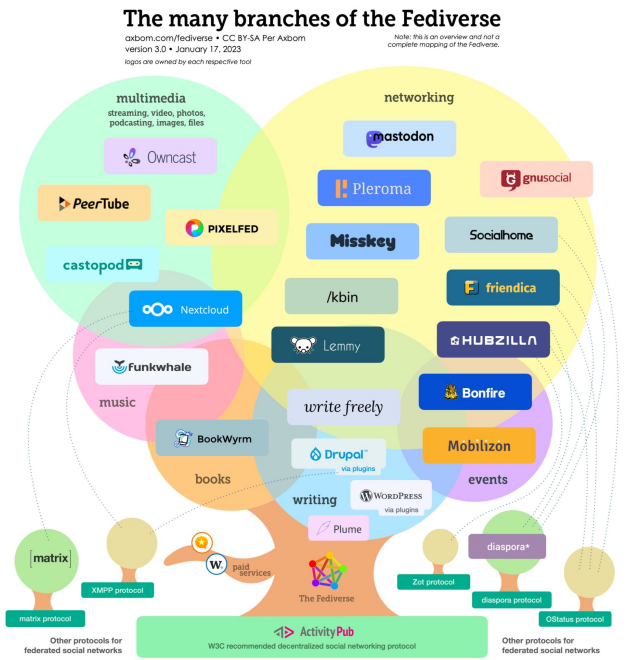
Picture from https://www.theverge.com/24063290/fediverse-explained-activitypub-social-media-open-protocol
To explore the opportunities of the Fediverse, BBC R&D has set up a Mastodon server for BBC accounts, a decentralized social networking platform that is part of the broader Fediverse. This not only puts the BBC in control over their platforms, unlike in their other social media accounts. It also gives users the opportunity to find BBC platforms easily through their more conventional social media accounts.
Less is more for NRK
Just like BBC, Norwegian public broadcaster NRK is stepping away from conventional social media platforms. Big tech companies have long been acting as a gateway to public service media platforms, but traffic from third party platforms to own platforms is dropping drastically. To better reach younger generations on their own platforms and sites, NRK cut back their social media accounts from 600 to 20. What remains are five main accounts, two news accounts and a handful of deliberately created test accounts.
The test accounts are solely created to test out content on third party platforms, see what works there and incorporate that onto NRK’s own platforms. NRK’s main social media accounts, on the other hand, are designed to drive users back to NRK branded platforms. They have clear NRK branding and will often include links to download NRK’s apps or to stream their tv shows. Finally, their two news accounts, one on Instagram and the other on Snapchat, keep youngsters informed with platform specific news content. These formats are also used for NRK’s own news website, leading to higher engagement with the formats that audiences know and love from other popular social media.
Unconventional social media use
Reaching younger audiences can be tricky in an online age where these audiences seem to favor the content and interface of third party platforms over our own. Yle, BBC and NRK show that, while challenging, reaching younger audiences on public service media platforms isn’t entirely impossible. Where changing format preferences and technology pose certain difficulties, creative solutions that explore unconventional social media use, can lead the way to better engagement with Gen Alpha.


