Mixing gaming and journalism: How your story can level up with gaming philosophies and mechanics

The media landscape is changing fast. Gamifying journalism might be one of the ways to combat the rise in users who avoid us, and to engage them more. Jump right in for some considerations to level up your story with non-linear storytelling.
Everyday we make choices that define what happens next.
Do I go to the breakroom for coffee now or later? If I do it now I'll risk being late for my next meeting. If I don't, I'll crave coffee for the entire time we discuss the agenda of today.
Same thing goes for the stories we tell our audiences. If you think about it, every story has a multiverse of possible storylines that could’ve happened if things turned out differently - or if we, the journalist, or the source simply did this, instead of that.
Normally, journalists focus on one storyline - the one that actually happens. But what if we made use of all the choices made along the way? The decisions that led to a specific outcome, which partake in shaping our world and society? The things that didn’t happen.
These possible storylines, realities that never really were, can be used to tell a more immersive story, give our audience a new perspective, and - if done right - give them power to control the narrative of what could have been.
A story as old as time … or, well, gaming
A lot of games use this process to create a story that is not just told - but experienced. Some of the best I've played myself is Detroit Become Human, The Mass Effect Series, A Wolf Among Us and of course regular Pen and Paper roleplay systems such as Dungeons and Dragons and Call of Cthulhu - there’s a lot to choose from. Another media using this kind of storytelling is Netflix’ Bandersnatch. Fighting Fantasy books are also a great example. They’ve existed since 1982.
Together, they’re examples of storytelling that exceeds a chosen narrative, instead giving the user a say in the matter: what do I do, when x happens? Well, as a gamer, that’s up to me.
I’ll argue that the potential of gamifying journalism is enormous. First of all, the time for challenging the way we usually do stories is now. The media landscape is changing. Fast. The amount of users avoiding traditional media is on the rise, and we are looking into a generation that prefers a more personalized experience.
Gamification of journalism might be one of the solutions to create more engaging and immersive personal experiences. In the following I’ll debate some of the practices and discuss how to handle the ethics, before jumping to the not so surprising conclusion that we should do it more.
Things to consider:
- Story over format?
- Level up with competition
- Is your story worth experiencing?
Story over format?
Danish newspaper Berlingske did their take on multiple storyline storytelling in this piece called: “Travel to the underworld of drugs: Make decision for the addict, the dealer and the crimelord” (translated from danish).
They've obviously put a lot of work into the piece, and they’ve created three storylines. One for the addict, one for the dealer and one for the crime lord.
But as much as it seems like a journalistic piece of work that aims to let the reader become the main character, the choices you make throughout doesn’t really matter when you look closer.
Quite soon you end up in a story-loop, where you return to the same question as earlier and is forced to take a different road than you might want to take. If my choices obviously aren’t the ‘right ones’ (e.g. the ones the journalist behind the piece wants me to make) why should I bother considering between two or three options?
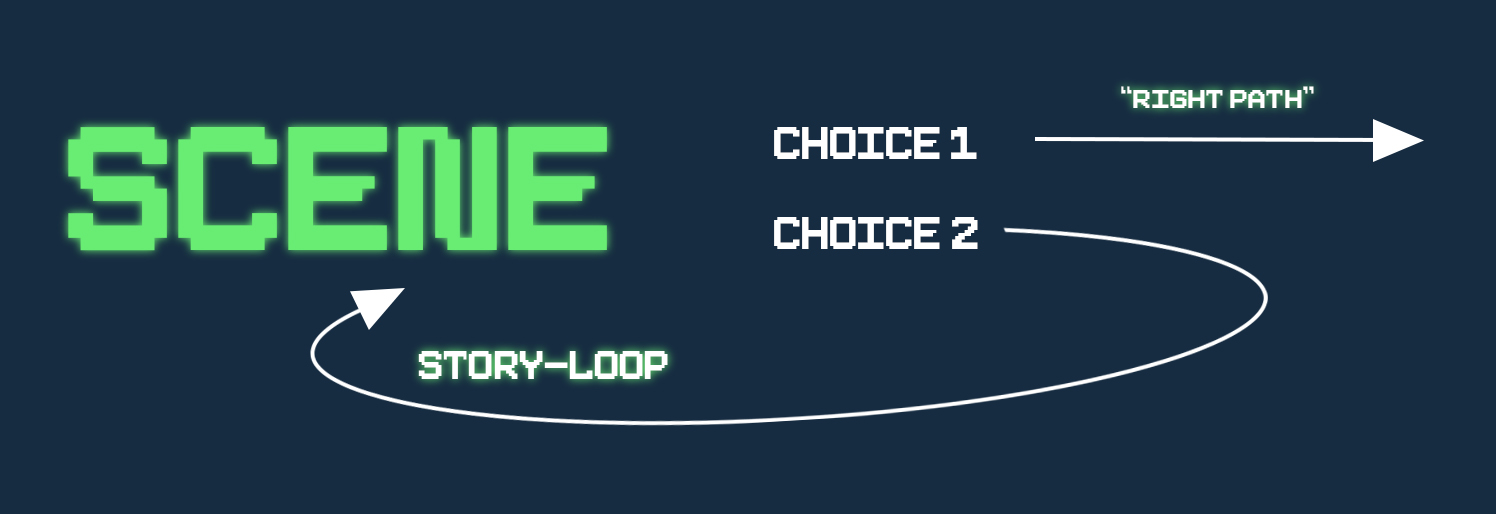
In this case, the format takes over the story. In my opinion, the story should never have one true path that it directs the readers down. If the story has a pre-destined ending, and you need your audience to go a certain path to fit the story, then it shouldn’t be told in a non-linear format. Otherwise you’re doing it just for the format.
Level up with competition
Letting our readers experience something can shed light on a topic that is difficult to explain all aspects of. For example, The New York Times did this piece called “You be the Ump”.
The debate, on which the story was produced, was essentially whether or not the umpires in baseball should be replaced with machines, which is actually an old debate that started back in the 60’s.
By creating a game on the above debate, they let the reader experience how difficult it is to decide whether a throw by the pitcher is a ball or a strike.
With very few mechanics - such as competition - they engage the reader, and the reader is immediately rewarded with a new perspective and more knowledge on what it means to be an umpire.
Is your story worth ‘experiencing’?
“You be the Ump” is an example of more traditional gaming mechanics put to use in journalism, where the main focus of this article is on the multiple storyline format. But it goes to show how easily a game mechanic can enhance a journalistic product to a level that gives the reader a much more deep immersion into a topic.
To create a journalistic piece with multiple storylines it has to be the right story. Not all stories are meant to be experienced.
Essentially a story will consist of scenes and decisions. One scene might lead to one, two, three or more decisions, which the reader might choose from. Every decision has a consequence, and when the first is made, the multiple storylines begin to form.
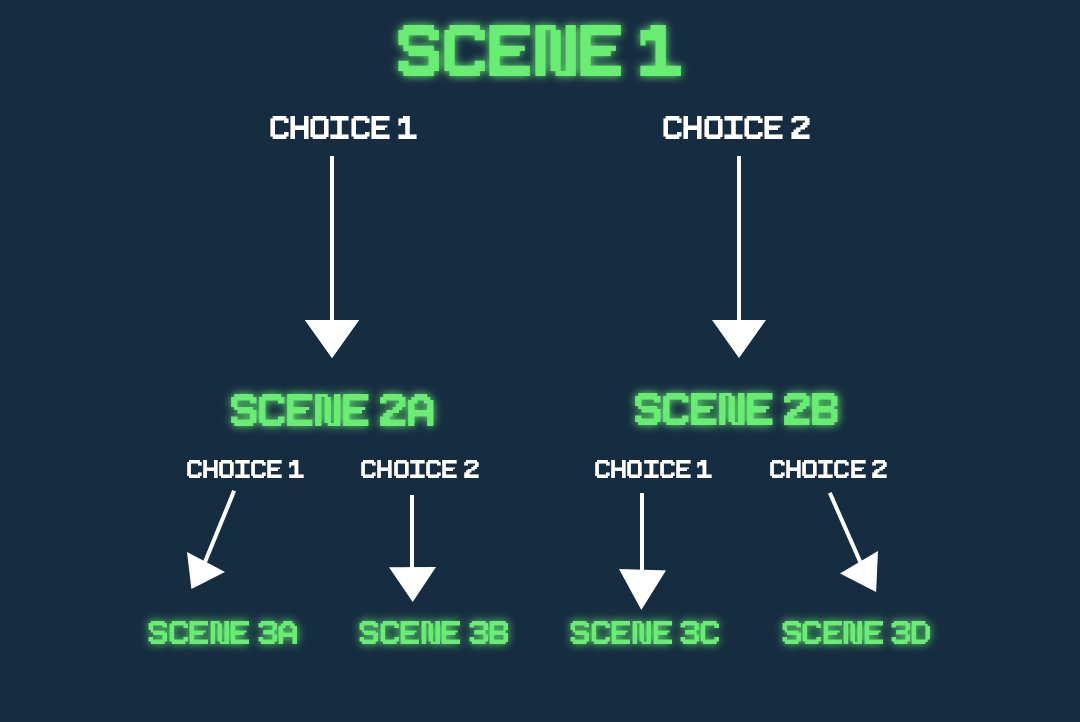
The story-tree, if you will, can continue to form new story-branches everytime a new scene is made. Often some decisions might lead to another branch. For example Choice 2 in Scene 2A might lead to Scene 3C instead of Scene 3B.
This is not easily handled. For one of my own projects I’ve used Twinery.org. A simple open-source tool to control your storylines, which can also build your project immediately for test drives.
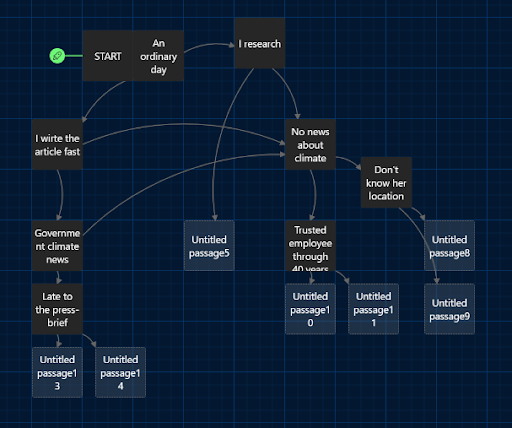
The illustration above is merely just the start of a story. It’s built for educational purposes for interns, letting them know how decisions made on a regular day with an out-of-the-blue “breaking news” story can affect whether or not they miss important information.
Some good rules of thumb to check if your story can be non-linear:
- Defining moments, where decisions create new paths
- No wrong or right paths
- More than one ending
Ethics, education and elaboration
As journalists we’re bound to report the truth objectively. Therefore there are some ethical issues when considering making a story as a multiple storyline format.
For educational purposes, it’s not an issue, but were I to publish the above, I need to be careful. One of the storylines is of course the true objective story. But the others are qualified guesses as to what could’ve happened.
I believe such stories can give readers a more immersive experience, and could shed light on a different perspective.
When I spoke on the subject to the GameHub members, a simple ‘declaration’ was one of the solutions we talked about.
You could label every non-true storyline scene and decision. I believe that will destroy the immersion, and let the players know ‘that they chose wrong’.
You could also make a very clear declaration in the beginning of the project. “This story contains plotlines that have not happened. Those will be revealed at the end.” Maybe this could even spark a motivation.
In my opinion you could make well researched “fake” storylines, which are supported by experts as to what would have been the most likely outcome of a different path. Here lies an opportunity to give insight and perspectives.
GameHub member Jesper Gojal Krogsgaard, TV 2 Denmark, said, “Usually there’s no wrong way of playing a game”, and I think that is very much the essence when designing and building a multiple storyline format.
Adam Partridge, Media Cymru, said “The key thing about ethics is giving people enough choice to make decisions or enough choices around the subject matter, so that you’re not directing them to a particular decision.” I believe this to be a key in forming the story. Pair that with Jesper Gojal Krogsgaards’ feedback, and there should be enough choices, in which none of them are wrong.
Not all stories that could - should be gamified. When deciding how to convey stories to our audience about injustices and challenges in our society, gamifying a story might not be the right way to express the gravitas of the issues being covered.
Choosing what to gamify - and how to do it - comes down to the story itself. What is the purpose of gamifying the story? What should it teach? Which experience are you looking to give your audience that could not have been told in a more ‘traditional’ manner?
The future is formed by gaming habits
Mixing journalism with gamification is a tool. The future generations are brought up with games. Gamifying journalism could engage users more, who might otherwise choose not to engage with us at all.
Multiple storyline storytelling is just one way of doing it. It’s applicable to most journalistic platforms. Depending on how our future looks, it might even be a completely natural way of telling stories, because many platforms will be born out of gaming communities (Metaverse, Roblox etc.)
I would love to see more journalists creating experiences for the audience in the future. With the ever changing media landscape, it might even be one of the few things we can do to compete and excel from other time consumers.
Does it require more time to produce? Yes. Is it worth it? Done right - it absolutely is. The users will spend more time with us, and to be honest it’s fun to create.
Anyway, I’ll go grab that cup of coffee in the breakroom now. Seems I’m already late for my meeting.


