Navigating media’s white noise era

The media industry has spent the past years experimenting with AI tools, testing productivity workflows and exploring new formats. But throughout the AI and media track at the Imec Technology Forum, the conversation repeatedly returned to a different question altogether: how do audiences still navigate information in an environment defined by overload, personalization and constant interruption?
That tension shaped nearly every talk during the afternoon. Speakers discussed AI assistants, archives, metadata systems, new discovery tools and newsroom workflows, but underneath those conversations sat the same broader shift: media companies are no longer only competing to produce information. Increasingly, they are competing to organize information and make it easier for audiences to find and understand. Justin Mol from DPG Media described today’s information ecosystem as a state of 'white noise'. “How can we remain a signal in the noise and avoid becoming a part of it?” he asked.
Media companies are still building for the current ecosystem
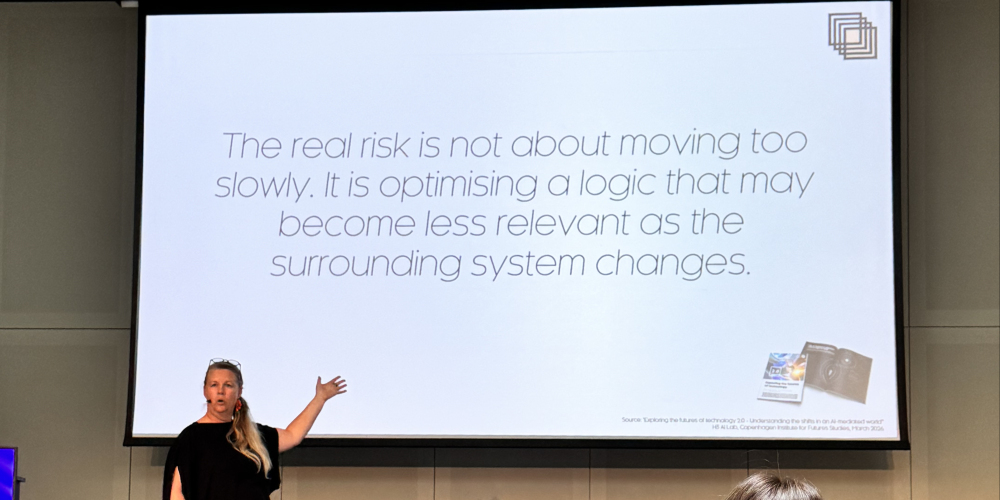
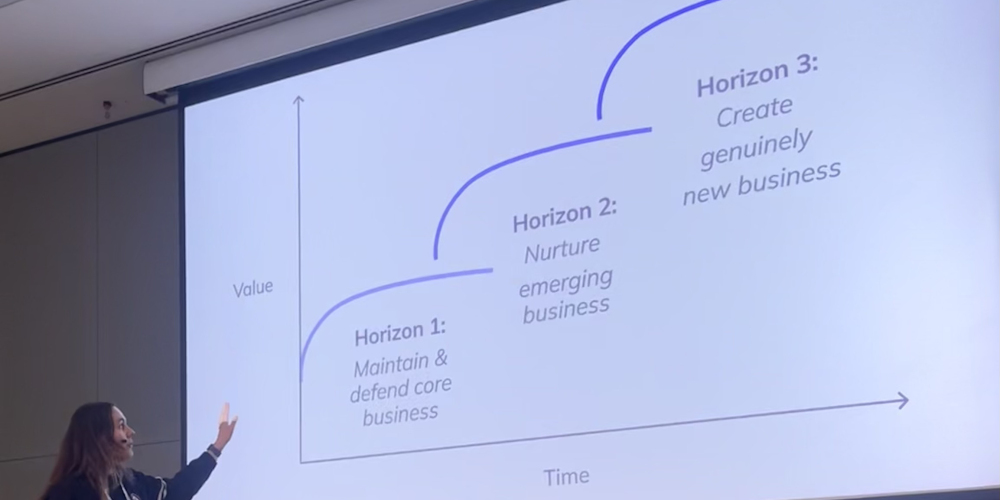
Sofie Hvitved, futurist and Director of Media Futures & Innovation at the Copenhagen Institute for Futures Studies, argued that much of today’s media innovation is still built around the logic of the current media ecosystem. Many organisations, according to her, are currently operating in horizon one: using AI to optimize existing workflows, products and processes. Useful, necessary even, but still focused on improving systems that may fundamentally change over the coming years.
Throughout the talk, Sofie repeatedly pointed toward longer-term shifts already starting to reshape media consumption and discovery: new interfaces, media built to work better with AI systems and more personalized ways of finding content. The challenge, according to her, is that much of the industry still approaches these developments through the logic of existing products and workflows instead of rethinking the systems underneath them.
That long-term thinking returned later in the afternoon during VPRO’s presentation on archives and metadata systems. Abel Enklaar reflected on projects VPRO started years ago around machine-readable archives, metadata systems and new ways of discovering content. At the time, many of these projects were still considered experimental. Today, they are increasingly becoming part of everyday media operations.
The comment captured one of the broader tensions running throughout the afternoon. Many of the projects now considered core infrastructure, from searchable archives to systems that help connect and organise content, originally started as Horizon 2, or even Horizon 3, experiments.
Several speakers argued that media companies are still too heavily focused on Horizon 1. But projects that initially seem experimental or peripheral often become foundational years later. The challenge, according to both Sofie and Abel, is making enough room for that longer-term experimentation before those shifts become essential parts of the media ecosystem.
Archives become infrastructure
One of the clearest examples came from Libelle Lekker, where Roularta's Publishing Manager Karolien Van Dinter presented Maia, the publisher’s AI-powered food assistant built on top of 15 years of editorial expertise, recipes and culinary archives. But Maia was never intended to become “just another chatbot.” The team instead approached it as an interface to trusted editorial knowledge. Maia also draws heavily from Libelle Lekker’s archive of food photography, with recipe visuals integrated directly into conversations.
Most of the time, we don’t.”
That insight fundamentally changed how Libelle Lekker approached discovery. Traditional search depends on intent. Users need to know what they are looking for. Maia instead tries to guide users toward inspiration, recommendations and contextual suggestions. One of the most successful features turned out to be the AI-generated suggested prompts placed underneath every recipe article. Rather than waiting for users to actively search, Maia continuously suggested related questions and ideas based on the recipe someone was viewing, significantly increasing traffic toward the chatbot itself. The results quickly revealed a behavioural shift: only 30% of questions asked to Maia were typed manually by users, while the remaining 70% came from AI-generated suggested prompts.
The assistant also became a way to reactivate the publisher’s existing archives. As publishers increasingly face pressure from platforms and AI companies, several speakers pointed toward archives and editorial expertise as one of the few truly unique assets media companies still own.
That same idea surfaced repeatedly throughout the afternoon. VPRO discussed efforts to create a “living archive” built around extra layers of information connected to archive footage, making decades of media searchable, reusable and easier to connect across topics and stories. Rather than focusing purely on retrieval, the goal was to move from “searching” to “finding.”
Associated Press was referenced as another example: not simply producing articles, but building systems that make content easier for AI tools to understand and connect. Throughout the talks, archives increasingly appeared less as storage systems and more as an important part of future media systems.
Together, these projects pointed toward a broader shift. AI is not only changing production workflows, but also helping audiences access existing expertise, archives and editorial knowledge. Instead of generating entirely new information ecosystems, many of the most grounded use cases focused on making existing editorial knowledge easier to access and reuse.
From search to guidance
Several speakers argued that changing audience behaviour is forcing media companies to rethink how people find and consume information. Justin Mol from DPG Media described how news consumption shifted within a single generation, moving from active information seeking toward far more passive ways of consuming information through feeds, notifications and social platforms.
“If it’s important enough, it will find me,” he said, describing the mindset many younger audiences increasingly operate within.
According to Justin, that shift fundamentally changes the role of media. News no longer exists in isolation, but competes continuously with messages, entertainment, social feeds and recommended content.
Many of the projects presented during the afternoon attempted to respond to exactly that shift. Maia’s suggested prompts significantly outperformed traditional search behaviour, while VPRO focused on better ways of helping users find information instead of simple retrieval. Rather than assuming users already know what they are looking for, several projects explored how media could help audiences find and understand information more easily.
That shift from search to guidance repeatedly returned throughout the afternoon. Instead of focusing purely on speed or efficiency, many of the projects focused on helping audiences orient themselves inside increasingly fragmented online spaces. Helping audiences find relevant information was becoming just as important as producing the information itself.
Trust in AI-driven media
As AI-generated content becomes more common across online platforms and recommendation systems, several speakers also reflected on how media organizations maintain trust inside those environments.
Interestingly, the panel largely resisted simplistic “AI labeling” solutions. Transparency, they argued, extends beyond simply tagging content as AI-generated. Instead, they emphasised making journalists themselves more visible by showing who creates journalism, how editorial choices are made and how stories are verified. That idea also connects closely to projects like VPRO Medialab’s “Glass House of Journalism,” which explores how making the journalistic process itself more transparent could help rebuild trust with audiences.
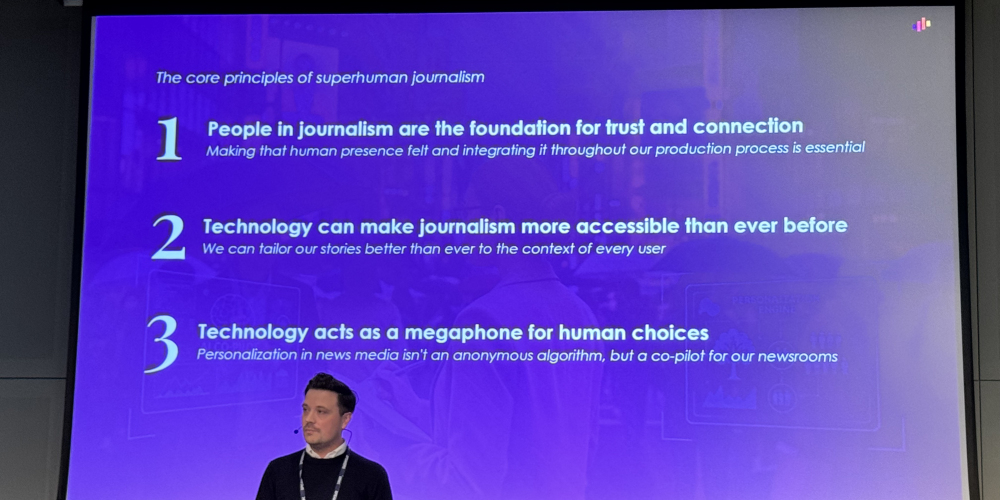
For DPG Media, that also means thinking beyond AI as purely an efficiency tool. Justin described the company’s vision of “superhuman journalism”: journalism that keeps people at the center, while using AI to support and strengthen human storytelling.
Key takeaways for media organisations
- Several speakers argued that media companies are still too focused on improving today’s systems, instead of experimenting with the infrastructures and media systems that could become essential in the future.
- Archives emerged as one of the industry’s most valuable assets. Projects like Maia and VPRO’s archive work showed how years of editorial expertise can become active, searchable and reusable through AI systems.
- As audiences navigate increasingly fragmented and noisy online environments, several speakers argued that media companies should focus less on producing more content and more on helping audiences discover, understand and navigate information.
Looking ahead
Throughout the day, one idea kept returning: in increasingly fragmented and noisy online environments, media companies will need to do more than simply publish content.
At the same time, we see how archives are evolving from passive storage into active systems that can continuously bring forward relevant content and editorial expertise across different platforms and products. For many media companies, these archives and years of editorial expertise may become one of the few truly unique assets they still own.
Rather than competing on publishing volume alone, several speakers pointed toward a future where media organisations play a larger role in helping audiences find relevant and trustworthy information within the constant flow of feeds, recommendations and notifications surrounding them every day.
In that sense, the "AI in media" conversations at ITF World, organised by Imec, focused less on automation alone and more on how media organisations can help audiences navigate an increasingly overwhelming flow of information. From archives and editorial expertise to trust, transparency and liquid media, the discussions repeatedly returned to one broader question: what role should media play in an AI-driven world?
The conversation continues throughout the second season of our Future Media Hubs Podcast AI & The Media World, recorded in connection with ITF World. All speakers featured throughout this article, including Karolien Van Dinter, Justin Mol, Abel Enklaar and Sofie Hvitved, will each appear in their own episode exploring many of the themes discussed during the event in greater depth.


