AI showcase: innovative stories behind European (and Brazilian!) media companies.

Generative AI is increasingly a part of our daily (work) lives. We write an article, but need a brainstorming partner for the title, or that one extra hashtag for our LinkedIn post. We receive a hundred-page long report and would love to get that easy summary. Or we clone the voices of our favourite radio show hosts and let our listeners guess which one is the real host.
However we use it, Generative AI has become our partner in crime on many areas. We hosted an AI session and gave our members the opportunity to bring an AI case that they are working on or that has (successfully) been implemented in their company.
AI history
Before we go into the different cases, we have to take a step back and look at the history of Generative AI. Machine Learning has been in our midst for over 70 years, with the first mention of Artificial Intelligence being made by John McCarthy in 1956. But with many obstacles, the biggest being the lack of computational power, it took some time before AI was really introduced in general society. Since 2010, AI boomed due to big data and new computing power and we started interacting with it. In 2011, Apple’s Siri was introduced to the world and in 2018, the OpenAI released the first version of GPT (Generative Pre-trained Transformer). But the hype cycle accelerated with the launch of Dall-E in 2021, OpenAI’s multimodal AI system that can generate images from text prompts, setting the way for many more AI-models to be used by media companies for targeting, segmentation, personalisation and content generation with text-to-image, synthetic voices and so much more.
Over the past 2 years, AI-tools improved and increasingly gained more capabilities. The MMLU score (Massive Multitask Language Understanding) is a benchmark for evaluating AI models’ language understanding capabilities across diverse tasks, ranging from mathematics to literature and even history. While in 2022 this score was approximately 40.0, we now see AI models with scores of 90.0. For example, OpenAI’s GPT-4, with a MMLU score of 86.4, shows that it has complex problem-solving abilities and can cover a wide range of topics. AI-models are expected to gain even higher scores in 2024, meaning they are becoming more intelligent every day.
A(m) I in Green, Amber or Red?
Matthew Blakemore, CEO at ‘AI Caramba!’, gave an overview of how to navigate the challenges, ethics and responsibilities of AI in media. To do so, he made a traffic light system: Green means it is an important challenge, but most of the time we’ll be able to cope with it quite easily. Amber items are more challenging problems and Red means it is extremely important that we try to overcome this challenge as soon as possible.
Starting off with the Green challenges, Matthew addresses the upcoming SLMs (Small Language Models) that companies are building specialized to their needs. Finnish public broadcaster Yle is one of those examples and build ‘Yle GPT’, their own, custom made, browser interface for OpenAI’s GPT models that is tailored for journalists and content creators to effectively utilize LLMs (Large Language Models) in their work. It started as a small experiment at first to help journalists learn new skills and ways of working with AI and became immediately very popular, especially the shared prompts feature where you can see how colleagues are using AI in their work.
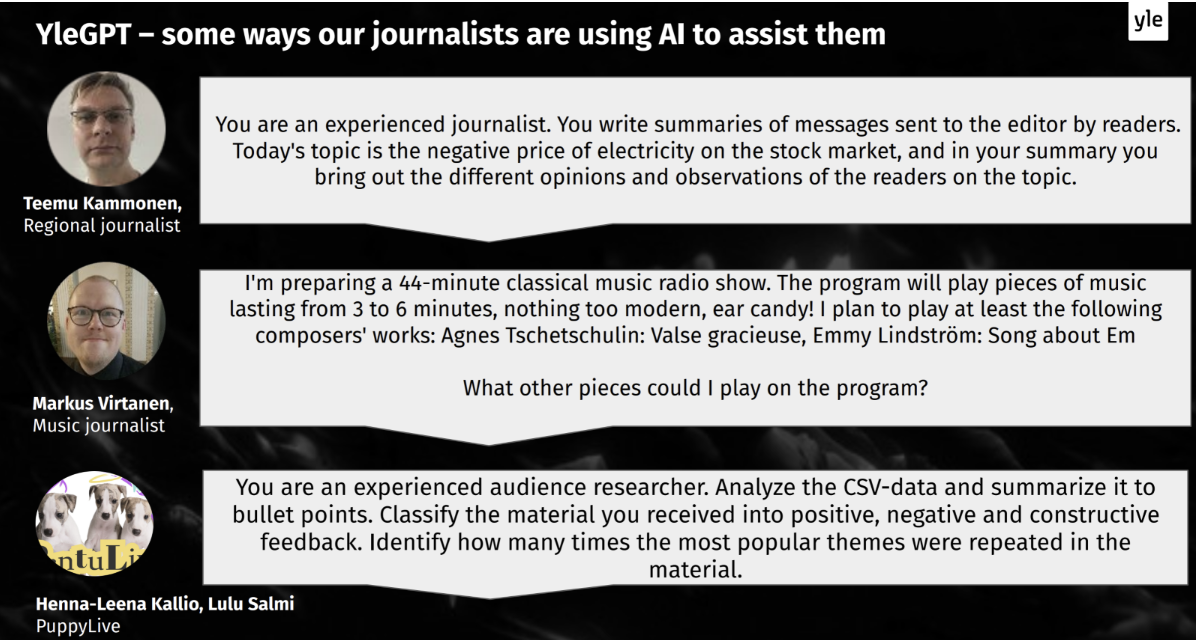
Today, more than 250 Yle employees are using the interface and plans are being made to broaden Yle GPT to incorporate more features, such as AI-tutorials or a shared backlog, and other LLMs in the upcoming months. The goal is to create their own AI-ecosystem to experiment with various AI-tools in a responsible and ethical way.
“Giving everybody a chance to learn how to use AI in their work is probably they key to putting AI into reality in everybody’s work.” - Jyri Kivimäki
On to the Amber lights, we find data utilisation and management challenges with regard to privacy, security and ethical usage. It’s important to move from just talking about ethics to actually involving diverse perspectives in the AI-development across companies. Transparency really is key in the upcoming years, with the European AI act coming into force and the ISO introducing a new certifiable standard ‘ISO/IEC 42001’ that offers a framework for ethical AI use. With an emphasis on risk management, data protection and transparency, companies will be able to gain a certificate which will give their boards confidence that their AI-teams are working ethically.
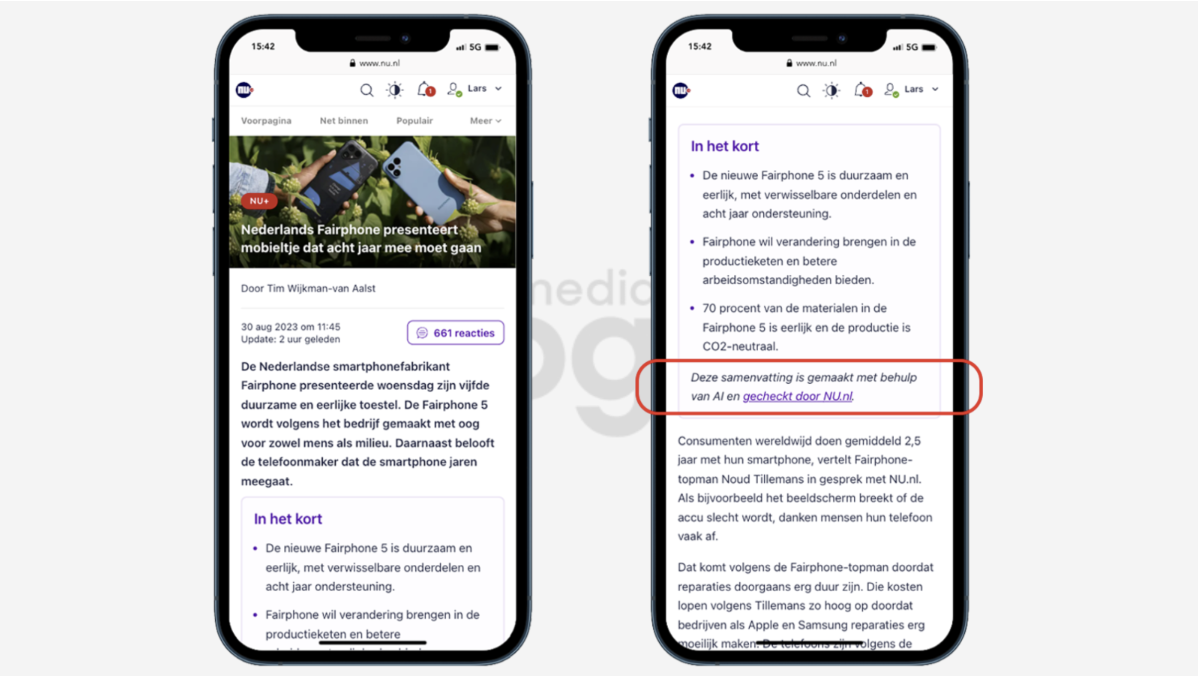
Eventually, the use of AI in our content will come down to the question “Do users want to see AI-generated content?” For example, at ‘NU.nl’, the biggest online news site in the Netherlands and part of DPG Media, readers get the choice to read an AI-generated summary of an article, before deciding to read the full article. But as in every use case, AI is still a human story and each summary is checked by the journalists before publicating it online. Feedback of the first tests indicate that the tool is a good support for journalists and helps them be more efficient by diminishing time-consuming and repetitive tasks. On the other hand, the quality and reliability of the AI-generated summaries is not yet up to speed, and DPG Media will continue testing with other AI-models to improve this.
Another example can be found across the world at Globo, where they used AI-generated images to accompany the recipes on ‘Receitas’ to drive more engagement, a higher conversion and better SEO. Based on different variables, such as the ingredients, type of kitchen and type of image, the Google Cloud Vertex AI will generate images matching the food.

Coloured as a Red flag is the potential of AI to cause job displacement. According to a recent Goldman Sachs report, 300 million jobs stand to be impacted by AI and automation. But Accenture estimates that AI will increase productivity in the creative industry up to 40% by 2035. Thus, if used responsibly and ethically, AI can also create jobs.
One of the presented use cases was VRT’s use of Autopod, an AI plugin in Adobe for multi-camera editing. By detecting laughs, coughs and facial expressions in the audio tracks, the AI will automatically cut the video to a different camera that gives the best view for the specific setting. With “Zware Klap”, a monthly podcast of 1h30, as an example use case, the VRT Video Snackbar team was able to edit in only 10 minutes using Autopod. The results were quite good, but still needed some manual adaptations, indicating that it is a good starting point for editors and can save them a lot of time.
At DPG Media, they asked themselves the question “Can we automate and simplify repeated tasks in the Video Newsrooms?”, such as transcribing, subtitling or putting highlights in the video-edits, receiving text-summaries for video descriptions or adding metadata tags for archiving. They put a team together, checked out various AI-tools and came with solutions that help their journalists save time.
Conclusion
Generative AI is here to stay, and it has been for a long time. From its first mention in the 1950s to recent breakthroughs like Dall-E and GPT-4, AI has transformed how media companies operate. It can be a helpful tool and save a lot of time for media creators. But the human touch and knowledge is still crucial before making the content publicly available. For example, in the case of NU.nl, ChatGPT 3.5 outcomes were significantly less correct than GPT 4.0 outcomes, implicating the need to scale AI-solutions to become more trustworthy.
Everyone is working with AI and increasingly implementing it in their company’s. But guidelines or certificates such as the ISO/IEC 42001 are recommended to make sure it is used in a responsible and ethical way, and to leverage the benefits AI can bring.


