Creators in search of independence

The creator economy is projected to reach $500 billion by 2027. Meanwhile, the traditional media business model is collapsing. The bond that once tied journalists to a newsroom for their entire careers no longer holds. Into this gap, some journalists are making the leap and becoming content creators themselves. But this transition is neither easy nor necessarily desirable, as it demands an entrepreneurial mindset (self-promotion, audience building, personal branding), often far removed from the journalistic role. To support this shift, organisations founded by former journalists are emerging to help their peers enter this new economy.
All media outlets are now questioning how to collaborate with content creators. V Spehar, of Under the Desk News (3.5 million followers on TikTok), shares their approach: focus on long-term partnerships — like those built with the LA Times or The Washington Post — rather than one-off token campaigns.
What sets creators apart from traditional newsrooms is a more refined mastery of their chosen topics, and above all, a direct relationship with their audience — via platforms and algorithms they remain dependent on. In this model, the audience effectively acts as editor-in-chief.
“I talk to my audience every day. […] We produce information together. It takes something from me, but it gives something back too.”
V Spehar is also clear-eyed about the context: this connection often takes place in intimate spaces — in the bathroom, not the family living room in front of the TV. Aware of their vulnerability to algorithms, they encourage creators to join Substack, now seen as a safer haven. Adeline Hulin, from UNESCO, adds: if journalism is a function, then content creators (or “nano-newsrooms,” as defined by Ezra Eeman) also fall under the protection of that function.
The creator economy is taking shape: more and more brands are investing in this new digital space, where independent content draws in large youth audiences. “We are clearly witnessing a transition: advertising budgets are shifting from old formats to these new ones,” observes Johnny Harris, a former journalist at Vox turned YouTuber. Brands follow the audience: according to a Deloitte study, 56% of Gen Z find content on social media more relevant than traditional films or TV series, and nearly half feel more connected to online creators than to TV anchors.
But creators consistently debunk the myth of instant, effortless fame. V Spehar launched their career while working a full-time job. Johnny Harris (6.5 million subscribers on YouTube) openly admits that it is his wife who handles the marketing.
For Johnny Harris, successful creators are those who master a specific subject. A useful reminder for newsrooms, which sometimes abandoned expertise too quickly, believing it was enough to look good while speaking for 1 minute and 20 seconds on television.
Being a journalist and being an entrepreneur are two very different roles, which holds many journalists back from going solo. “You cannot expect all the best journalists to also want to become entrepreneurs,” explains Harris, pointing to the financial risks and stamina required to launch an independent venture.
All observe the same trend: social platforms, saturated by the attention economy, are no longer enough. Creators are turning toward subscription models — thereby entering into direct competition with traditional media. But even on Substack, according to Taylor Lorenz (formerly of The Washington Post, now independent), you need to publish at least four to five times a week to have any hope of gaining traction.
@underthedesknews We knew he was gonna try- now we see how it’s fought. #news#justice#constituiton#uspolitics#martiallaw♬ original sound - UnderTheDeskNews
To address these obstacles, Johnny Harris designed a transitional structure based on subscriptions and advertising, serving as a launchpad into the creator economy while shielding journalists from the more complex aspects of entrepreneurship.
“They do not necessarily want to run an organisation, hire staff, handle taxes, or negotiate brand deals. What they want is to do journalism,” he adds.
Reinventing the distribution model for field reporting:
At the same time, Jane Ferguson founded Noosphere, a video platform designed for independent journalists, often working in conflict zones, to publish their reports freely and be paid directly by their audience. Inspired by Substack and YouTube, Noosphere operates on a subscription model: journalists receive 50% of the subscription revenue they generate, while retaining full editorial independence. The platform also provides logistical support (safety training, insurance, equipment), while allowing journalists to collaborate with other media outlets if they wish.
The challenge: breaking free from dependence on traditional platforms and giving power back to journalists. “No one can fire you,” says Ferguson. “Disintermediation is the future.” This model also addresses a constant pressure felt by creators: the need to post constantly just to remain visible. According to Patreon, 75% of creators feel penalised if they do not post regularly, fuelling fatigue in the attention economy.
Patreon is emerging as a cornerstone of editorial independence: during a parallel panel, several independent journalists explained how they are stepping away from traditional structures to produce content outside of industrial logic. Patreon offers a concrete solution for securing recurring revenue, enabling greater freedom of tone, and working for a committed community rather than for algorithms.
Adam Cole (HowTown) illustrates the demanding path toward autonomy: formerly with NPR, he recounts the contrast between initial hopes and the reality of launching independently. Today, his YouTube channel has over 719,000 subscribers. His model relies on three balanced revenue streams: one-third Patreon, one-third YouTube monetisation, one-third sponsorship through brand integrations. This mix allows him to create meaningful content, even for a smaller audience.
A strategy shared by other creators present: Samuel Muna, founder of an independent African media outlet, and Gloria Chan, co-founder of Green Bean Media, also use Patreon to build a stable monthly subscription model. The goal: to produce differently, without relying on massive audience numbers, by focusing on a direct relationship with supporters.
Johnny Harris summarises what makes his 40-minute documentaries successful: “A big part of my storytelling is taking the audience along the journey of how the information is built.” Objectivity is no longer the norm; trust now comes through authenticity. Young audiences, in fact, no longer share the same definition of news as traditional newsrooms — while still acknowledging that “authenticity is not the same as truth.” Asked about the size of his team: 17 people. “I accidentally became a media company.
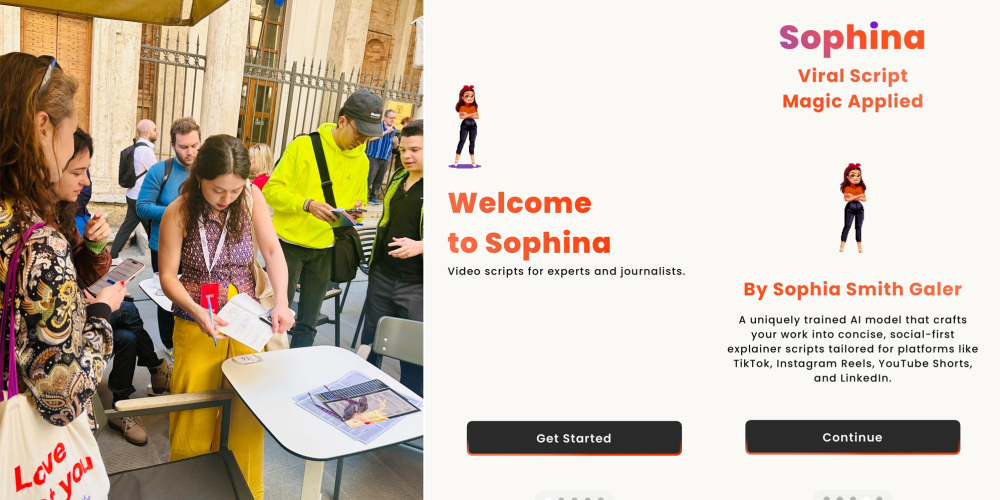
For her part, Sophia Smith Galer is working to diversify her income streams. She tested, on a café terrace, an app designed for creators that turns any text into a teleprompter-style prompt for recording a video. A minimalist interface aimed at simplifying the transition to on-screen presence. On social media, she believes the goal is no longer to “reach young people,” but to reach a broad audience of digital users. Her method: a 3-I formula.
Instinct: a story grabs your attention.
Insights: you verify all the facts, connecting them to what you have already covered.
Impact: what makes this content stand out from that of your competitors — because the space is saturated.
Once a pioneer, she now finds herself in direct competition with the entire ecosystem of news creators. And she reminds us that a 90-second video must be just as well-sourced and rigorous as a written article…