How Silicon Valley’s AI emperors are reconfiguring reality

Christopher Wylie, the whistleblower behind the Cambridge Analytica scandal, is sounding the alarm: Silicon Valley is no longer just a centre of technological innovation, but a dangerous ideological movement — a “religious cult.” “These are the richest men in the world, leading the most powerful companies in the world,” he states.
He is not alone in identifying the rise of an anti-human ideology, shaped by “tech bros” he bluntly calls “insane,” who are convinced that machines should replace humanity. He denounces a creeping “anti-humanism,” disguised under the polished rhetoric of progress.
According to Christopher Wylie, whistleblower in the Cambridge Analytica scandal, Silicon Valley is no longer just a technological revolution; it has become a religious movement — a “cult” led by billionaires and “tech bros,” by “nutters” who preach a vision of the future in which humanity is supplanted by machines. What sets this cult apart from others? Unmatched power. “These are the richest men in the world, leading the most powerful companies in the world,” he says. “When you have a group of men who believe they are going to replace humanity with machines, that is an anti-human ideology. And I think what continues to grow in Silicon Valley is anti-humanism. They call it transhumanism, but in reality, it is a desire to replace humans,” observes Christopher Wylie.
But this technological fanaticism is not being scrutinised enough, according to Julie Posetti (International Center for Journalists): “We are afraid to take the crazies seriously (…). These missions are real and fully funded.” She warns of parallels with the overly lax media coverage of Donald Trump. The whistleblower shares the same view: the press remains too passive, focused on the latest tools and not taking seriously the “prophecies” of these ultra-powerful men — who are now connected to the White House.
Christopher Wylie goes even further, calling Silicon Valley a fascist movement. He cites Marc Andreessen’s techno-optimist manifesto, which celebrates Filippo Tommaso Marinetti — co-founder of Italian fascism — as a “saint.” “Fascists have always been obsessed with the future. What were fascists thinking about 100 years ago? About strong men reshaping society to impose their vision of the future, and all the weak crushed beneath them in the name of a glorious destiny. Today, it is the same shit,” Wylie says bluntly. “Before we talk about regulation, we need to talk about how to resist fascism. How would we have regulated Mussolini, honestly?”
For him, a vast gulf has opened up between journalists and tech billionaires: “On one side, journalists are thinking about how to save technology; on the other, tech bros are thinking about how to live after democracy.
For Martin Andree, author of Big Tech Must Go!, the diagnosis is clear: Big Tech has taken control of the entire information ecosystem. All internet traffic now takes place within platforms — the result of a brutally effective combination: network effects, closed systems, the removal of outbound links (like a department store with no exits), content generated for free by users, and algorithmic self-referencing. Even the narrative of technological progress is controlled… by those who profit from it.
It does not matter whether journalism is publicly or privately funded: what we are losing is not the content, but its visibility. The printing press transformed distribution. AI is disrupting both production and distribution.
But Andree also puts forward concrete proposals: open platforms to outbound links; impose open standards; economically separate content production from distribution; cap market share at 30%, including for digital media; and ban the monetisation of criminal content (which should be self-evident).
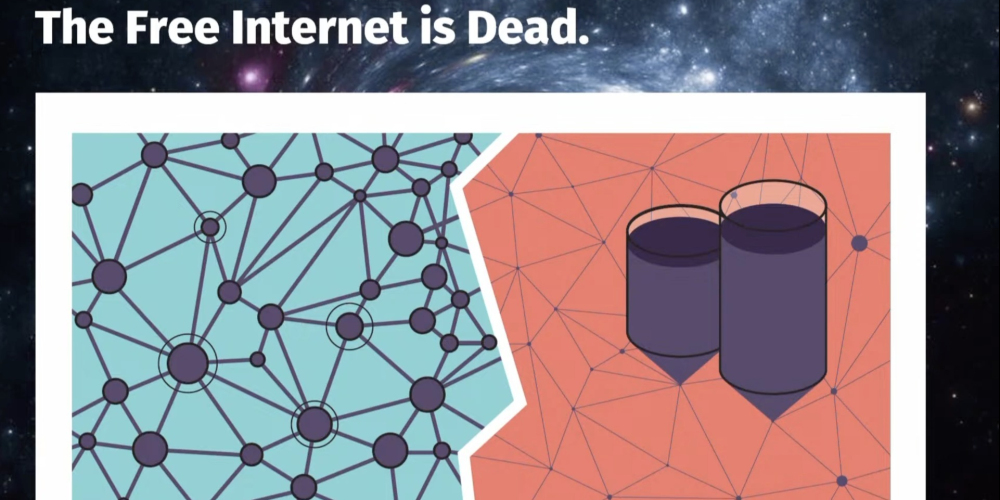
In the meantime, media outlets face a rigged choice, summed up in a simple diagram: publish on social media and work for free for Big Tech, or publish on their own sites and vanish into algorithmic silence. Martin Andree then raises the essential question: what are the implications for our shared reality? Are we entering an illusion — that of an open, participatory media space — when in fact, network effects create confinement, and the machinery is controlled by a handful of actors? Should a media monopoly not be considered unconstitutional? In his view, the point is not to regulate, but to liberate. “They stole the Internet.”
The debate should not be anti-technology, but should target the practices, abuses, and the hijacking of the word “tech” by a powerful few. “Silicon Valley has narcissistically self-proclaimed itself as the technology — which is absurd.” Christopher Wylie reminds us that the majority of engineers are genuinely committed to the public good: “We are against abuse, against the financialisation of all aspects of society, against emotional exploitation, and against the destruction of civil societies.”


