Revolutionising comment sections: How BR uses AI to structure audience discussions

Comment sections can get messy and impossible to follow. But instead of releasing you into the chaos, Bayerischer Rundfunk (BR) offers you another way. On their news site BR24, the broadcaster implemented a new way to make audience discussions more accessible. The result is an AI-supported feature designed to help readers find their way through fast-moving conversations more easily.
A practical response to overwhelming comment sections
BR noticed that some articles on BR24 get a lot of comments very quickly, making it hard for readers to follow the discussion. The editorial team asked the AI + Automation Lab if they could help make comment sections easier to use and understand.
The team built an AI feature that sums up comment discussions and shows the main themes right below the article. The goal was to give readers a quick overview and highlight viewpoints that might get lost in long threads. This should help readers identify the most important perspectives in the discussion and jump directly into the part of the conversation that interests them most.

Sharepic via BR/Max Brandl
Human moderation as a building block
BR used its existing human moderation process, so only comments that had already been reviewed were included. This meant the new feature could be added without giving journalists a bigger workload.
Editorial teams choose which articles use the feature, and it only appears once an article has at least 50 comments. This threshold ensures there is enough discussion for the system to identify meaningful themes. The tool then groups the discussion into topics, writes short summaries and selects example comments for readers to view and reply to. Every 15 minutes, the system checks for new activity, but it only regenerates the box if at least 10 new comments have been added. This prevents the overview from constantly changing because of only a few new replies, while keeping it up to date when the discussion moves forward.
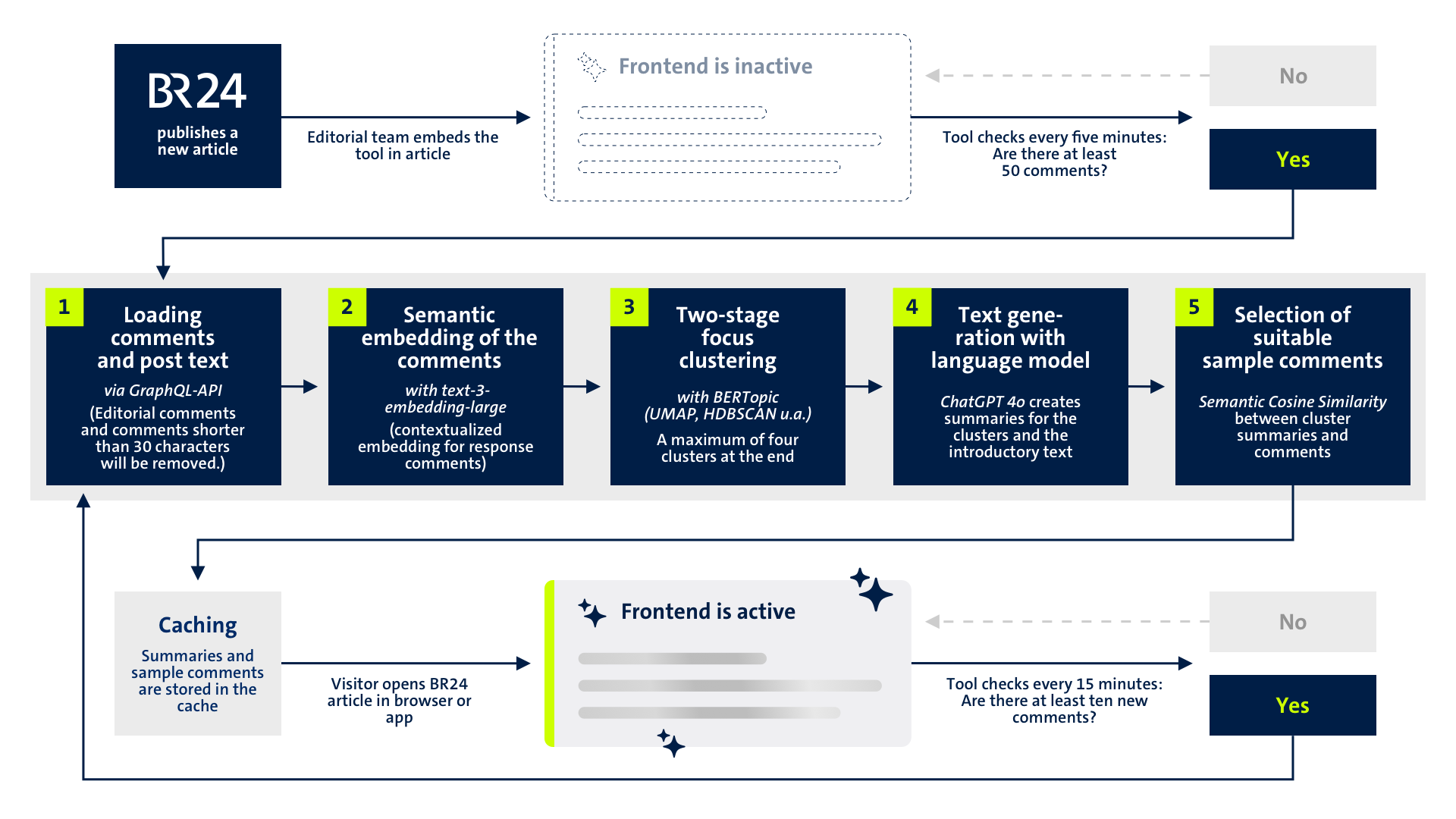 Architecture Flowchart via BR/Max Brandl
Visual optimisation in version two
The first version gave readers a short summary, followed by a more detailed look at up to four discussion groups. Users could open each group, read sample comments and go straight to the comment section. BR also included a feedback button so people could share their thoughts on the feature while using it.
BR used this feedback to redesign the tool. The team improved how the AI handles replies and comment context. On the user side, they improved the user interface and changed the summary for clearer topic headlines, making it easier to browse sample comments. They also let users hide the feature if they did not want to see AI-generated content.
While it’s hard to prove that the feature directly improves the quality of discussion, BR notices that users are clicking from the AI summary box into the comments more often. Since the feature appears right below the article, more people might notice the discussion before scrolling down. BR also believes this could make it easier for some readers to join in, compared to the actual comment section, which is placed much lower on the page. The tool gives readers a new way to see what is happening in the comments.
More than a reader feature
The summary tool for readers is kind of a follow-up to an earlier internal project, called “Dein Argument” (“Your argument”). Before making it public, BR used AI to scan comments for arguments, opinions and interesting points that could help editorial teams. That system is still in use and BR sees more ways to use similar tools on platforms like TikTok, Facebook, Instagram or other comment sections they manage.
This shows a bigger benefit for publishers. Analysing comments helps readers create and participate in debates and helps newsrooms spot new topics, common concerns or ideas for future stories. So, BR’s project is not just about summaries, but about making comment sections more useful for both editors and audiences.
Key takeaways for media organisations
This case offers useful takeaways for publishers on how AI can improve the audience experience without replacing human oversight.
- AI can help make comment sections easier to scan through. For publishers with lots of comments, summarising the main topics can help readers find their way faster and join the discussion more easily.
- Human moderation is still important. BR built the tool on top of their existing moderation process, so only verified comments are included. This lowers risk and keeps human oversight in the system.
- AI features should be updated through user feedback. BR launched a beta, asked their audience what it missed and rebuilt the feature for version two. They treated it as a product that could grow and change.
- Reader-facing AI works best when it stays practical. BR’s tool does not try to replace discussion, but to make fast-moving comment sections easier to scan and enter.
The BR24 AI-tool shows how even a small AI product can solve a real audience need. By giving the readers a guiding hand in chaotic comment sections, it turns a cluster of micro discussions into a more structured part of the news experience.


