SXSW 2025: Journalism in Times of Fading Light

2025, ever more immersive, ever more AI, and yet… almost too polished. This year’s SXSW could have been the stage for a live dystopia. But no: no rebellion against the tech bros and their new orange-faced Líder Máximo, not even a mention of the name that must not be spoken from Amy Webb, usually the high priestess of impending collapse. Instead, she chose to chart a path toward a more organic future, a kind of beyond (beyond reason?), tinged with esotericism, driven by “living intelligence.” Just that.
Eva Wolfangel, writing for the German newspaper Die Zeit, captured the moment perfectly: it was as if “the entire room had slipped into a time warp” in the face of a glaring lack of political context—something already evident during the Oscars ceremony. And yet, the atmosphere was far less relaxed than last year. In Austin, some American journalists were beginning to wonder whether they should undergo crash-course training on how to report under an authoritarian regime—perhaps even with an observational internship in Pyongyang, Tehran, or Moscow. Meanwhile, the so-called Land of the Free had just been placed on an international watchlist for its rapid erosion of civil liberties.
A festival looking towards the future… while avoiding the present
But little of this unease was reflected in the panels and keynotes of the 2025 edition. When Esther Perel was not inviting us to imagine “our preferred future,” resignation to apoliticism was on full display, particularly in a panel where young startup founders framed their struggle under the banner of “Gen Z vs. the Gerontocracy.” When asked why current political events were absent from their discussion, they responded: “Our first political memory is the 2016 election” (the one that brought Trump to power). “We never learned how to debate politics constructively.”
The same restraint was evident in a roundtable featuring NewsGuard and The Trust Project, dedicated to disinformation and the pressing new question: how to distinguish fact from fiction? A Washington Post editor was in attendance, yet there was no mention of Trump’s ongoing strategy to discredit the press, nor of Jeff Bezos’s quiet influence on his newspaper’s editorial line. “We agreed not to discuss current politics,” the BBC moderator apologized, without elaborating.
SXSW could have been a laboratory for rethinking journalism in the age of AI. But here, evasion was the preferred approach. As if neutrality had become the only acceptable stance in a polarized world. Or perhaps it was simply a matter of economic survival, given that media outlets, too, depend on the very platforms they should be scrutinizing.
Galloway, Controlled Dissonance?
Scott Galloway, another star futurist at SXSW, did not hold back. On stage, he delivered a performance mixing provocations with a vulgar Trumpo-Muskian imitation—perhaps one reason why the replay of his keynote mysteriously disappeared from YouTube. True to his style, he denounced the “domino of cowardice” among tech CEOs, slipping in a few borderline Nazi-virilist jokes along the way.
His grand narrative of the moment? A world where young men are increasingly falling behind young women, retreating into a filtered digital existence shaped by algorithms, where a single podcast could overturn an election, and where we overprotect children in the real world while underprotecting them online. Galloway, in fact, ended his keynote with a passionate call to make more children.
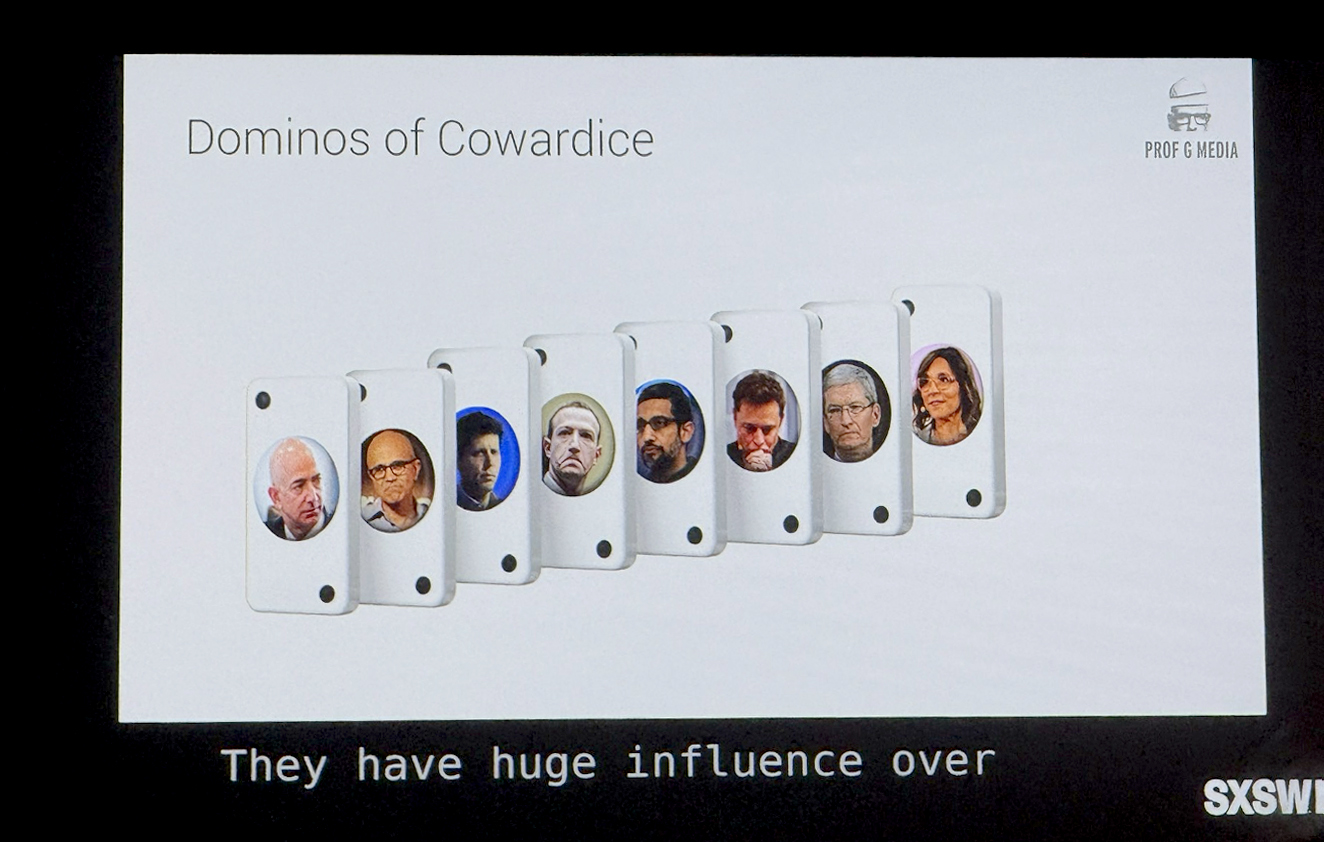
Screenshot presentation Galloway
When AI Writes History… and Politics
During a live recording of her new podcast with her brother, IMO with Michelle Obama & Craig Robinson, Michelle Obama posed a simple yet unsettling question: “Who do we want to be as a nation?” before pivoting to more personal topics. On the media stage, a different question loomed: How far will AI go in shaping journalism? At the panel Byte by Byte: Decoding AI’s Impact on Journalism, Rubina Fillion (The New York Times), Aimee Rinehardt (AP), and Elin Wieslander (Aftonbladet) discussed AI-powered investigative reporting. The New York Times insists on keeping a human in the loop, while Sweden’s Aftonbladet takes things further with "election buddies"—robot journalists leveraging RAG technology and human-verified data, relying on GPT-4o for Swedish-language output.
Meanwhile, Associated Press expressed concerns about controlling large language models—without once mentioning its contract with OpenAI. At this pace, why stop at election coverage? Why not automate political analysis and editorials too? One AI to ask the questions, another to write the articles… and journalism becomes a perfectly closed system.
AI’s Truth: Recycled and Optimized
This question also took center stage in a panel featuring Nvidia, Typeform, and researchers from the University of Texas, discussing “The Impact of Simulated Data on AI and the Future.” As AI models exhaust real-world data, the obvious solution emerges: generate the world instead of observing it. Digital twins, simulations, synthetic users—each pushing the boundaries of illusion.
But how far can we go before AI starts feeding on its own illusions? The discussion touched on “nutritional labels” to indicate error margins and self-correcting loops to prevent drift. Yet, the real priority seems elsewhere: cutting costs, moving faster, producing more. In 2023 alone, AI discovered more proteins through synthetic data than in centuries of scientific research—a breakthrough for humanity or just a runaway feedback loop?
And what happens when AI starts recycling its own simulations? If even AI no longer processes reality, what happens to journalistic truth? We risk entering a world where everything looks new but nothing actually means anything. The specter of “model collapse” looms large—where AI-generated content becomes an echo chamber of the predictable. Truth turns into a luxury. User research, once essential, becomes a mere adjustment variable. Yet, amidst this infinite generation and loss of reality, one certainty remains: human-generated data will only grow in value.
Journalism Beyond the Web: Adapt or Disappear
At the AI x Journalism House, hosted by Hacks/Hackers and the Online News Association, Der Spiegel raised a critical question: What role will AI play in independent journalism? Stefan Ottlitz, Co-CEO and Head of Product, painted a stark reality—news organizations must embrace hyper-personalization or risk irrelevance in an increasingly fragmented information ecosystem. News is no longer static; it moves, morphs, and adapts to user behavior. The traditional article is just one touchpoint in an expanding universe of virtual events, interactive storytelling, and immersive experiences. The challenge? Thinking beyond the web itself. In a world where AI-driven chatbots are set to replace traditional search engines, journalism must evolve—not just in format, but in function.
If users no longer search for news but instead receive pre-filtered responses from AI assistants, how do media organizations ensure they remain authoritative sources? What happens when journalism is reduced to an answer, stripped of nuance, context, and investigation? The industry is facing a crossroads: either integrate AI in a way that strengthens editorial integrity, or be reduced to raw material for algorithmic curation.
More or Less Accurate Predictions
As every year, MIT presented the 10 most disruptive technologies, much like Scott Galloway, assessing which predictions had proven accurate, which had missed the mark, and even, in full transparency, which had been left off the list this year—such as flying taxis or, surprisingly, AI agents: “still too basic, but probably next year.”
Neil Redding took it a step further, asking: "Giving instructions to AIs is one thing, but has an AI ever given you instructions?" In his view, the agentic era is dawning: as AI agents become increasingly autonomous, the business world is poised to become both stranger and radically more efficient (where, for instance, everything becomes "shoppable"). An AI that, little by little, seems to be developing a life of its own.
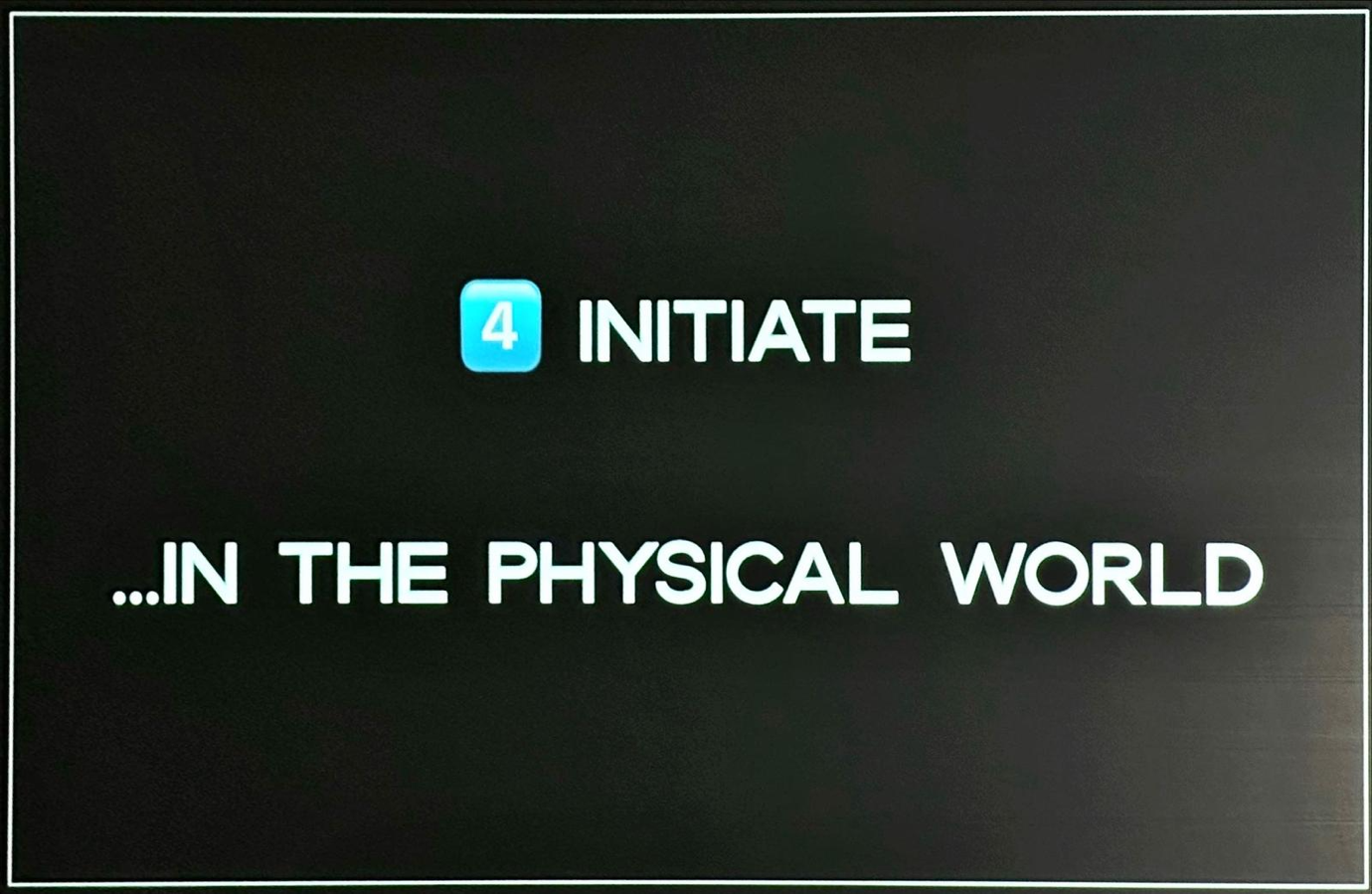
Phase 4/5 of Agent Usage: When They Start Acting Autonomously
Meanwhile, according to Prof G (Scott Galloway’s nickname among insiders and his students), no company is better positioned than Meta to take the lead in AI. Nine out of ten internet users (excluding China, the undisputed leader in Big Data) use its platforms. The result? Access to an unmatched wealth of unique human linguistic data—raw gold for training AI models—far exceeding that of Google Search, Reddit, Wikipedia, and X combined (though not necessarily of higher quality than media sources).
And generative AI arrives at the perfect time, in an era overloaded with choices, where too many options ultimately kill choice itself. Every year, we spend the equivalent of a full week just deciding what to watch. "TikTok is Netflix with an AI layer that eliminates choice," sums up Scott Galloway.
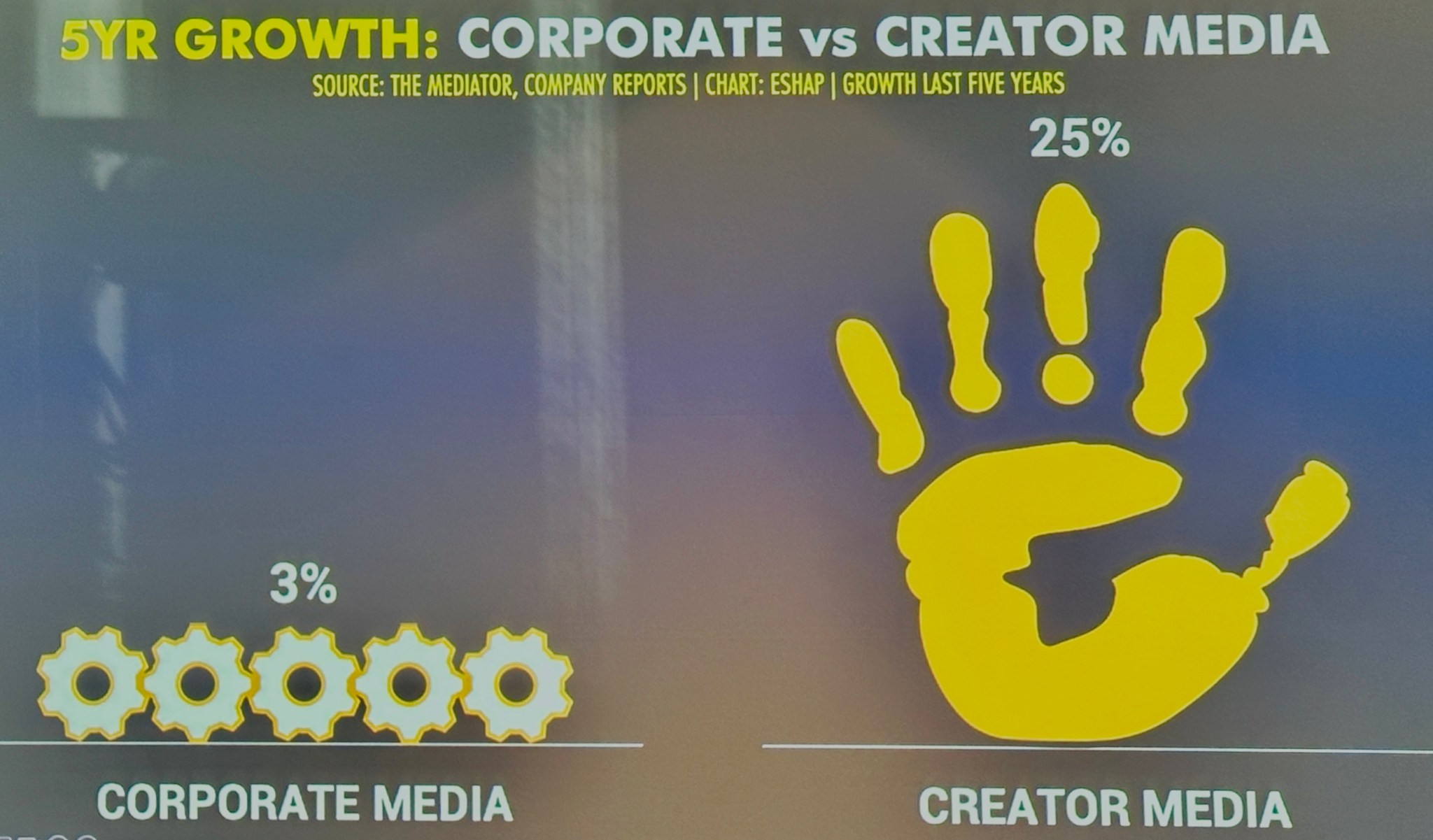
Slide Evan Shapiro
The real war for attention
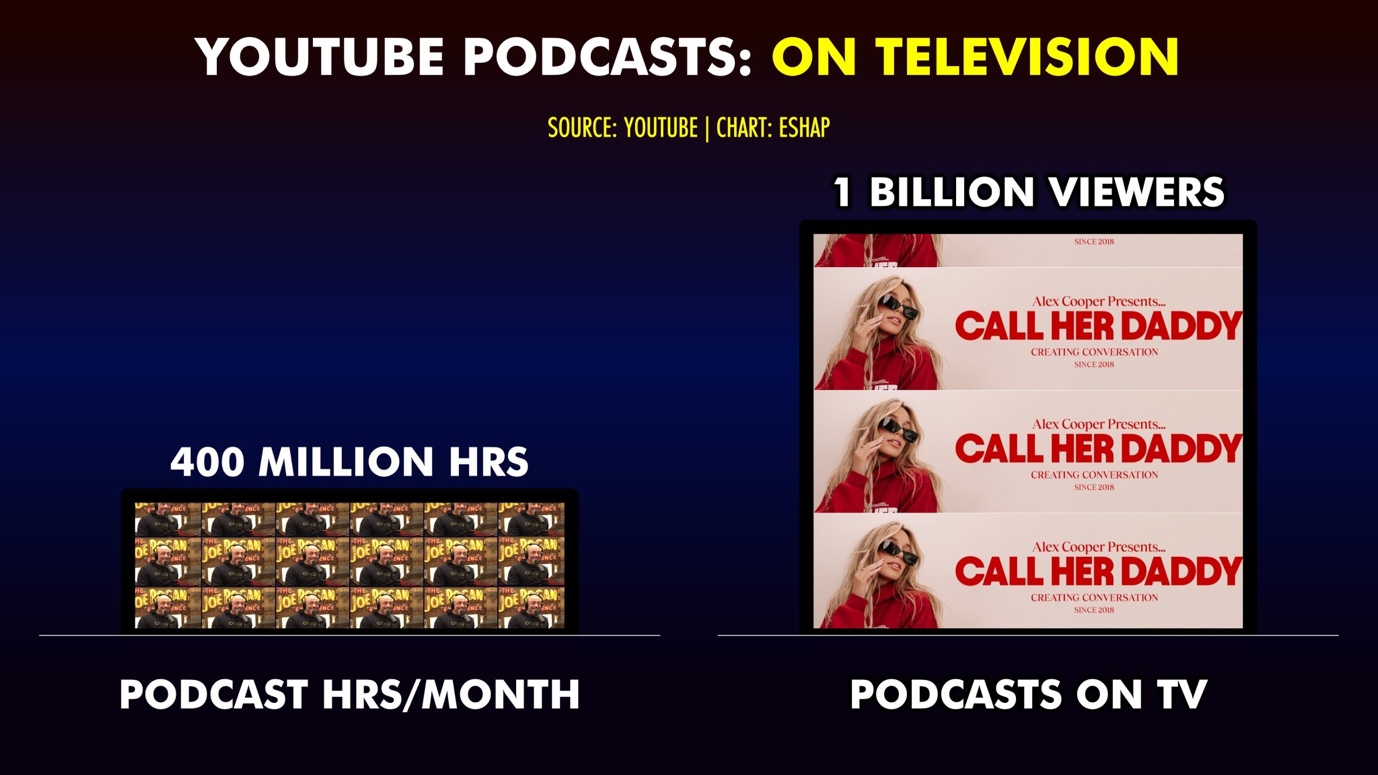
And we know it: Netflix did not win the so-called streaming war—YouTube did. Evan Shapiro, a brilliant media cartographer, had predicted this shift long ago. At SXSW, he took the opportunity to dissect the evolution of media models, steering clear of meaningless panels in favor of real, unfiltered conversations. At the Content Crossroads event with Future Media Hubs, he led discussions on the user-centric era, the transformation of fandom, the optimization of media interfaces, and the apparent death of DEI (Diversity, Equity, and Inclusion).
On the podcast stage, Shapiro made a striking point: one billion people now watch podcasts on TV. Instead of stating the obvious, he dedicated his time to answering real questions from creators—how to integrate video and monetize content in the new multi-revenue creator economy. In this battle for attention, traditional news media is no longer even on the front line. The fight is happening elsewhere—between platforms, AI, and creators.
Slide Evan Shapiro
AEO, the new SEO
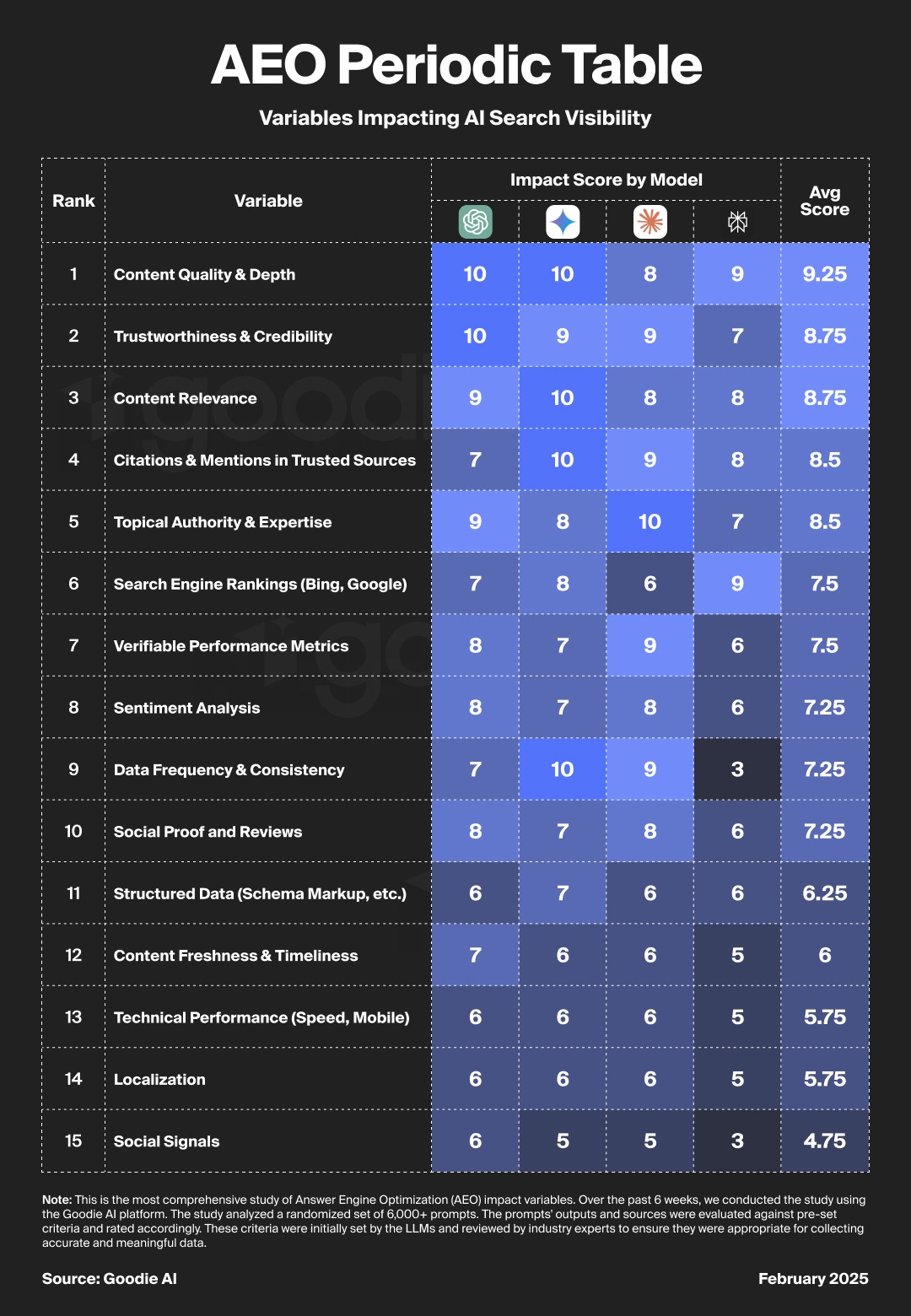
In this AI-driven world, content creators, newsrooms, and influencers must learn the new rules of visibility: SEO is out, AEO (Answer Engine Optimization) is in. Goodie AI conducted a six-week study, analyzing over 6,000 randomized queries across ChatGPT, Gemini, Claude, and Perplexity to quantify the factors influencing AI search rankings. The findings, presented in a periodic table format, reveal some good news: content quality still matters most (Score: 9.25)—reminiscent of Google's early, idealistic days.
But here comes the bad news: it is no longer an algorithm ranking information—it is AI deciding what we need to know. No direct access to sources, just a single, pre-validated, pre-filtered answer. The real question: who decides what gets through?
Goodie AI
The International Innovation Front
Due to the political context, Canada House remained closed, and Chinese delegations were notably discreet. In contrast, the UAE made a strong statement, showcasing an annex of Dubai’s Museum of the Future, an immersive installation by Refik Anadol, and high-caliber panels. One standout session, moderated by Felix Zeltner (Remote Daily, the world’s first virtual talk show), featured Patrick Noack (Dubai Future Foundation) and Matt Carmichael (What the Future – Ipsos), questioning the very essence of futurism as a profession.
A new idea? Inertia, often underestimated, may eventually reassert itself—even though, at present, nothing seems to indicate such a shift. The experts, however, remained convinced: predictability will make a comeback. Let’s hope they are right.
Could Europe Be the Last Hope?
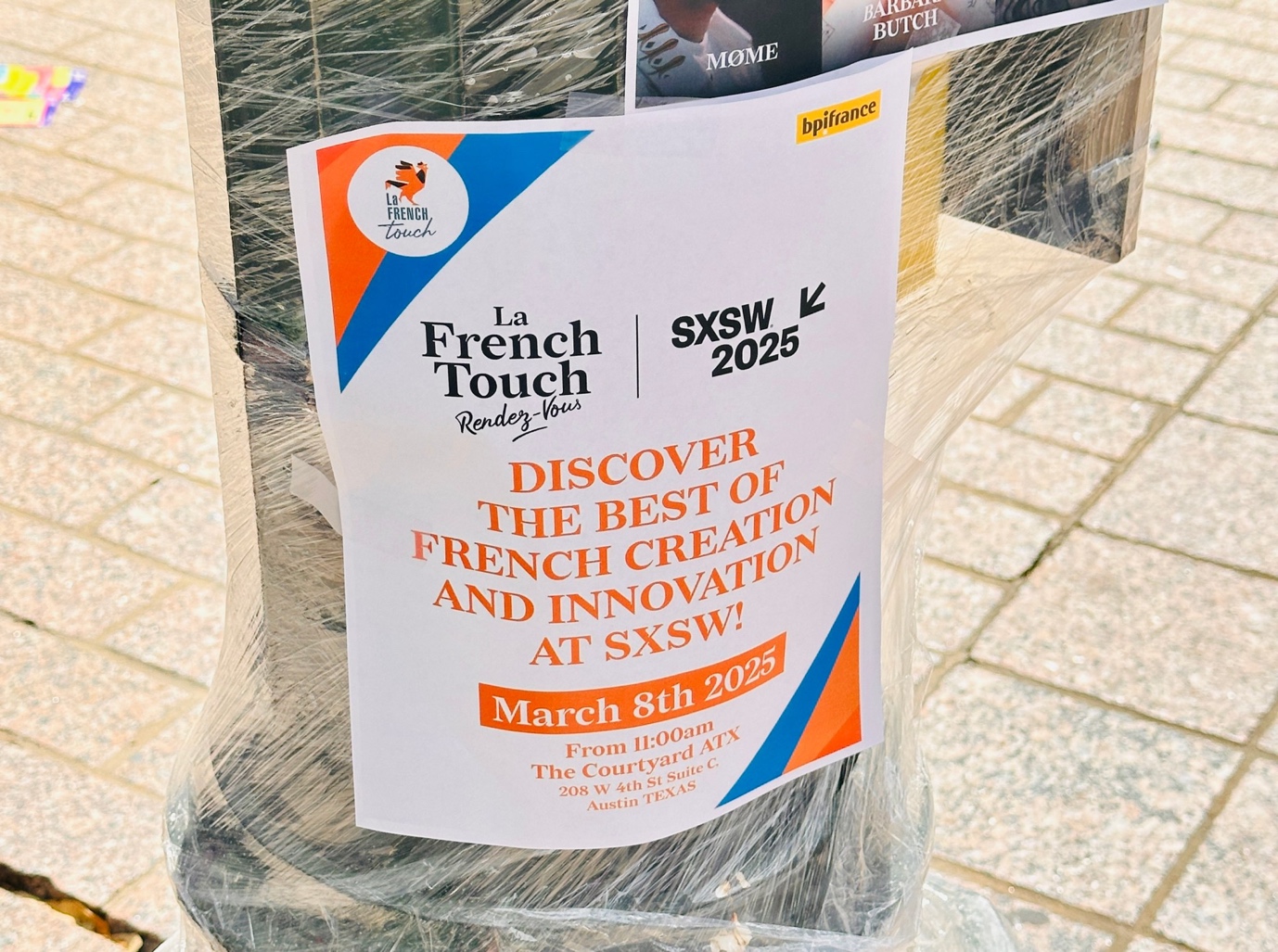
At the very least, France’s cultural sector made a strong impression at SXSW, arriving with a 60-strong delegation led by Bpifrance, French Touch, and we are_, in partnership with the CNC and Valeo. The delegation was highly visible, from panel discussions to key moments like the presentation of the Olympic Games opening ceremony, and the participation of Hugo Travers, a prominent content creator.
For Nicolas Dufourcq, CEO of Bpifrance, SXSW remains a critical platform, bridging the ultra-innovative American ecosystem with the expertise of French cultural and creative industries. But this is no longer just about cultural influence.
In his assessment of the event, he sounded the alarm:
"Europe must make decisions. We must beware of the predation of what we might call 'oligarchs of tech'—but also of Chinese groups that will dominate robotics hardware. We need to set our terms: we want Joint Ventures, technology transfers, restrictions if necessary. But all of this must be part of a structured recovery plan, akin to the post-war era—one that requires a strong, coordinated European Union that abandons its inter-state rivalries and finally learns to cooperate, for real."
Last year, French company Enchanted Tools won the Best Product Design award for its humanoid creations, Miroki and Miroka, redefining the real-world applications of robotics. This year, French companies once again stood out at the SXSW Innovation Awards, including Wandercraft, a robotics company that is gaining increasing international recognition. The future of AI is undeniably physical, but its real power will lie in mastering data.
The most effective dystopia is the one we fail to notice
What will our future be made of? Lab-grown bio-computers, mammoth farms, flying taxis piloted by AI agents, and journalism where automated "buddies" moderate debates—so neutral they cancel themselves out. Meanwhile, the last human newsrooms, reduced to mere accessories, will hesitate between aligning with the vision of their billionaire owners or publishing a multi-format liquid editorial generated by GPT-10.
Will information become instant, pre-packaged, filtered by algorithms so advanced they cannot be questioned? Will truth—or rather, accuracy—turn into a nostalgic relic, buried in the archives between a deepfake report and a perfectly tailored podcast feeding every cognitive bubble?
SXSW is meant to decipher the future. But by consistently avoiding reality, it risks turning tech into a spectacle and the media into mere extras. Between two radically different futurologists—Amy Webb, who champions data-driven analysis, and Scott Galloway, who swears by pure "gut feeling"—which path to follow? SXSW remains a unique cocktail of tech, film, entertainment, and business, infused with discussions on society and health—an unmatched format, except perhaps in London, where the festival's first UK edition will take place in early June. With, perhaps, a touch more political boldness?
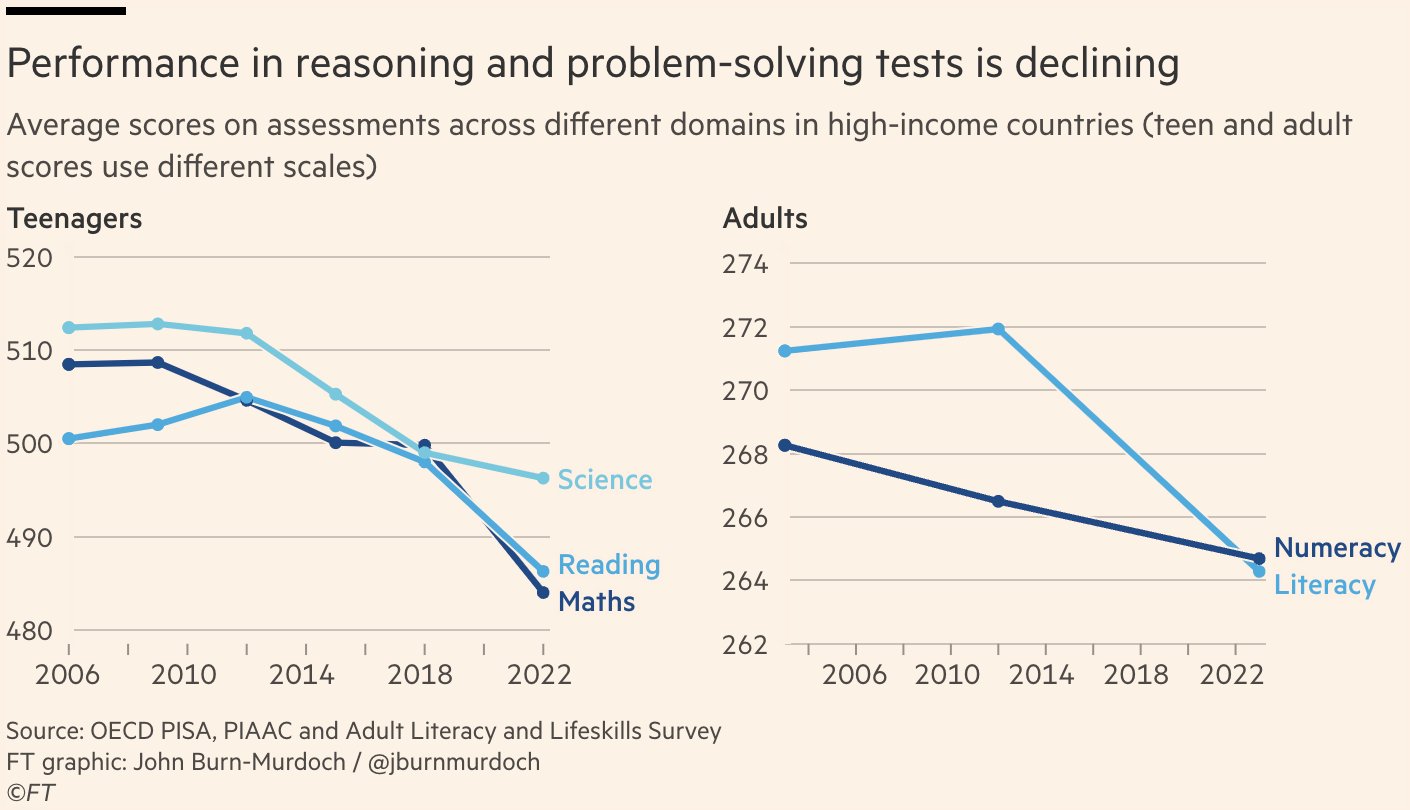
What is certain is that technology—and AI becoming increasingly tangible (robotics, machines, new materials, health technologies, as already seen at CES)—is not necessarily beneficial to our brains. This Financial Times graphic makes it clear: we lean on AI as a crutch when it should be an accelerator of thought—to paraphrase (somewhat freely) Yoshua Bengio.
As the light dims on information, erasing doubt and nuance, perhaps it is time to look up. To demand something other than a future pre-written by algorithms and dictated by Big Tech executives. And above all, to prove that human editorial teams still have a reason to exist.
In the end, the greatest dystopia may not be one where AI controls everything. It is the one where we grow accustomed to it all—without even realizing it.
Photos : KB