The User-Centric Era Is Here: Welcome to the New Ecosystem

The media landscape is undergoing a major shift that is driven by changes in consumer behavior. Those who traditionally held the least power—creators and audiences—are now fully in control of their feeds, platforms, and subscriptions. This means that, for the first time ever, big media has to follow the audience and not the other way around. How can media companies and advertisers rethink their business models and measurement strategies for the user-centric era?
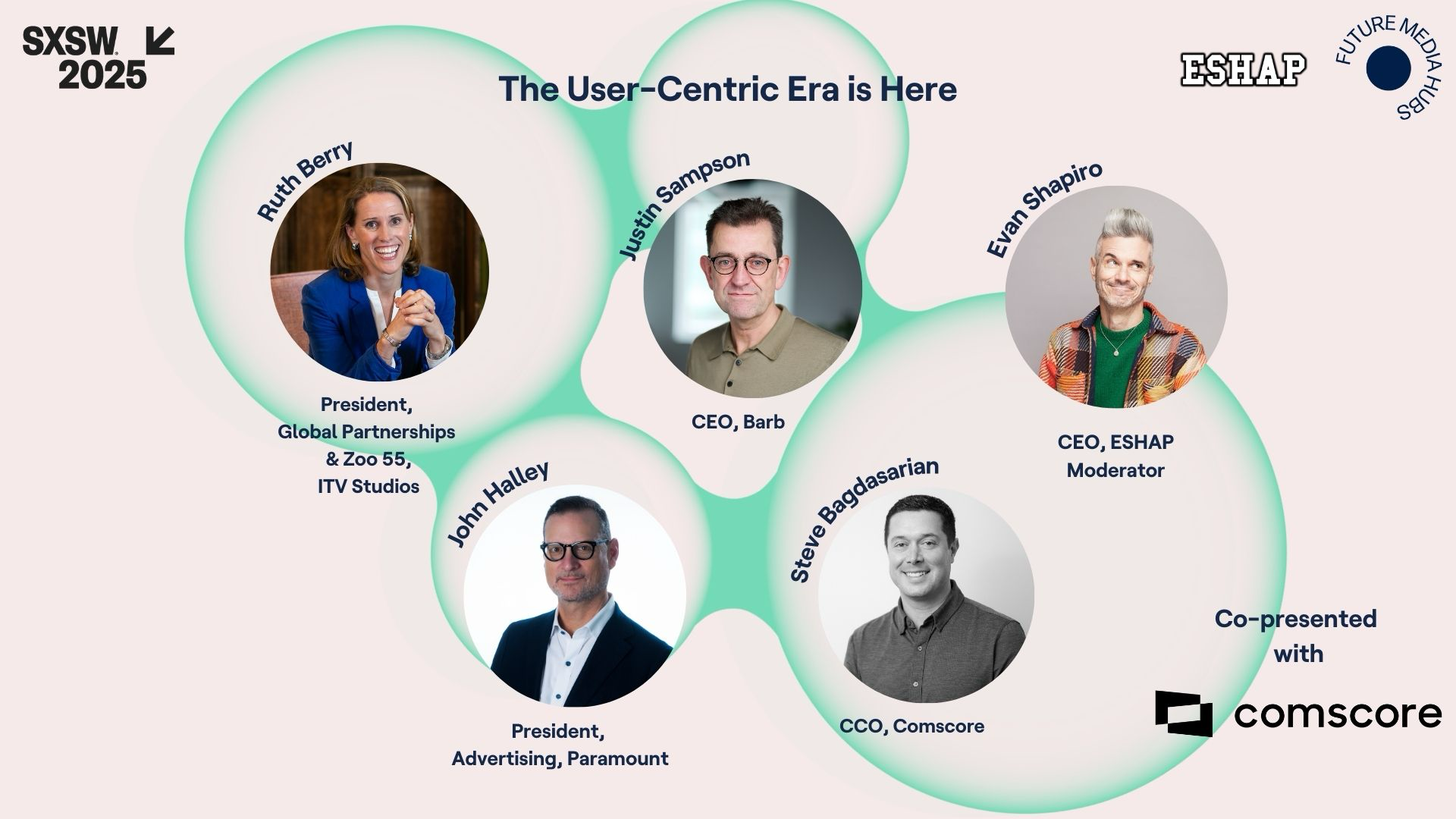
A panel of industry insiders that are at the forefront of this change, consisting of Steve Bagdasarian (Comscore), Ruth Berry (ITV Studios), John Halley (Paramount), and Justin Sampson (Barb Audiences), moderated by Evan Shapiro, shared their insights into the opportunities—and the pitfalls—of this new dawn.
Paramount: Adapting to New Engagement Models
John Halley, President of Advertising at Paramount – one of the largest media companies in the U.S. and Europe, known for its premium long-form content – discussed how audience engagement with content has fundamentally changed.
Traditionally, big media companies like Paramount focused on selling ad space based on reach, using metrics like GRPs (gross rating points). Then, advertisers followed a structured marketing funnel: TV for awareness (getting people to notice a brand), search for consideration (when people look for more info), and shopping for the final transaction. But today, this funnel isn’t accurate anymore. People’s journeys are much more fluid: they scroll, stream, shop, and search all at once. In the meantime, digital platforms like Facebook and Instagram have taken an increased share of ad spending, partly because they can show brands exactly how their ads lead to specific business outcomes. So, how can a traditional media company battle that metric-based buy cycle that is so powerful in the marketplace?
Paramount has to prove that their ads also drive results and not just reach. To do this, they partnered with Circana, EDO, and Mastercard to track how watching a Paramount show impacts actual purchases. This helps them prove their monetary value in a more data-driven way.The goal is to shift the conversation away from just CPMs (Cost Per Thousand, a metric used to measure the times an ad is shown) and toward real business outcomes—how much revenue do those ads generate?
However, a fundamental problem for traditional media is that social media platforms seem like they convert better, but that is not necessarily true. Social media platforms win because they’re mobile-first, which makes it easier for users to take action. But social media is also full of fake profiles and bots that make it seem like an ad has reached more people than it actually did. In addition, Paramount has shown that non-skippable advertising on the TV screen wrapped by long-form, more highly engaging content is more cost-effective than marketing on social and the most valuable converter of attention.
To truly compete, big media companies must redefine how they measure success and prove that long-form, premium content is just as valuable as social media advertising—if not more so. The key is tracking actual outcomes by showing advertisers how many people not only saw an ad, but also took action and making buying through TV just as easy as it is on a mobile device, so it fits the way people engage with content today.
ITV Studios: Expanding Distribution Beyond TV
Ruth Berry, President of Global Partnerships & Zoo 55 at ITV Studios, home to 60 production labels in 13 countries, shared how ITV Studios is adapting from licensing content to TV networks worldwide to creating its own digital-first strategies instead of only relying on traditional TV deals. With success, because in 2024, ITV content had 25 billion views across social platforms, showing that digital content is now a major part of their business. Now, ITV is working on ways to monetize that digital audience better and use data to shape its future strategy, consisting of three pillars:
- Turning Their Catalogue into Digital Video
ITV has tons of content that wasn’t being monetized before—like documentaries, human interest stories, shock docs, and nature programming. That is why they set up a digital team within the traditional distribution business that focuses on taking this content and publishing it directly on online video platforms under branded channels like Our World or The Voice. This experiment proved wildly successful, leading to billions of views per year across 160 channels.
- Zoo55 and FAST TV
Here, ITV goes beyond YouTube and social media by actually building its own digital-first TV channels under the brand Zoo55. Zoo55 is a FAST channel. FAST stands for Free Ad-Supported Streaming TV—basically, digital TV channels that work like traditional TV, but stream for free and are supported by ads. This is important because instead of just posting videos on YouTube, ITV is now building entire digital TV networks that can bring in ad revenue. With results: in just three years, Zoo55 has grown to make up 15% of ITV’s revenue. Their goal is to double that by 2027.
- Gaming and Fandom
ITV owns the IP for Love Island, a massively popular dating show among younger audiences. That is why this Peacock (US) hit proved the perfect opportunity to expand into the gaming universe. By creating the Love Island mobile game where players can become a character in the show’s world, ITV is reaching new audiences who might never watch traditional TV—but still love the brand and will spend money in other ways. For example, in the game, people are buying virtual bikinis every second—meaning ITV is making money off the in-game purchases.
According to Ruth, it’s time to start seeing social media as an opportunity, not a threat. Many traditional broadcasters have seen platforms like YouTube and TikTok as competitors rather than partners, but ITV is doing the opposite: they embrace social media not only as a revenue stream, but also as an audience builder.However, when working with platforms like YouTube and Facebook, collecting data can be a challenge. This is another reason for ITV to move from being a B2B licensing model (exclusively selling shows to TV networks) to direct-to-consumer, where they own the data, audience, and revenue.
Barb Audiences: Measuring Fragmented Viewership
Barb Audiences is a not-for-profit that provides independent and standardized audience data. About eight years ago, Justin Sampson, Chief Executive at Barb, noticed a growing gap in their measurement because the amount of “unknown viewing” that was growing rapidly: traditional broadcasters were losing viewers to streaming platforms like Netflix, Prime Video, and YouTube.
Although these streamers had their own internal data, they lacked context. Without an independent way to measure that audience, streamers did not know how streaming fit into broader viewing habits. The most pressing issue here was that the industry needed independent data to understand how TV and streaming were competing and where they were overlapping.
That is why Barb developed independent methods to track streaming viewership across the UK by using WiFi Router Meters to track what people watch by measuring traffic on home networks, using big data to identify viewing patterns and match them to audience demographic and measuring viewing across TVs, laptops, tablets, and phones.
So how do people watch TV now? Barb categorizes viewing into three main buckets:
- Total broadcast (linear TV & streaming services), mostly watched on TV screens
- Pay VOD (Netflix, Disney+), again, mostly on TV screens
- Social video (YouTube, TikTok, etc.), primarily watched on phones and laptops, but TV screen viewing is growing, especially on YouTube
YouTube’s growing presence on TV screens (40% of UK YouTube viewing happens on TVs) suggests a shift towards long-form engagement, resulting in the blurring of the lines between TV, streaming, and social media—which means that advertisers and media companies need better ways to track and understand where audiences are spending their time.
Comscore: Evolving Measurement Standards
When there are two different ecosystems growing, what do you measure? And what do clients want to see measured? Do they care about how many people watch or about whether ads are effective? Isn’t it logical that, with people changing the way they experience content, the way we measure also needs to change?
Enter Steve Bagdasarian, Chief Commercial Officer at Comscore. Comscore has been measuring TV and advertising for 25 years. Seeing the shift happen firsthand, it’s clear that the old way of measuring data—focused on TV ratings—isn’t enough anymore.Steve emphasized that traditional and digital advertising are converging, and that measurement must evolve accordingly. With advertisers being increasingly focused on ROI (return on investment), they require a more granular, real-time insight at the mid-funnel stage (where people are considering a product, but haven’t bought it yet).
Today, the real “remote control” is our phone—it complements everything we watch. This means that viewing and purchasing behavior are blending together and the key takeaway is that measurement isn’t just about where people are watching; it’s also about understanding how advertising works at different points in the funnel—instead of necessarily tracking what users do immediately after watching. This means that data must be available faster. Besides that, there needs to be better tracking of how well ads influence consumer consideration, not just whether they were seen or clicked. The future of measurement isn’t about counting views—it’s about understanding audience behavior and proving that ads actually work.
Conclusion
The media and advertising landscape is evolving faster than ever. To stay ahead, companies must rethink their distribution model and be present on multiple platforms. Besides that, measurement standards also need to evolve with consumer behaviour and ask the “how is the audience engaging and what actions do they take?” Instead of only who is watching. Lastly, media companies need to realize that social media platforms like YouTube and Facebook are not a threat, they are opportunities to be leveraged as tools for audience growth and brand awareness.
Whether you're a media executive or advertiser, the time to rethink your strategy is now. Embrace data-driven insights and meet your audience where it’s at —because the future of media belongs to those who adapt.
To delve deeper into these discussions and gain valuable insights, watch the full session here.